Dualism offers us binary options that must be challenged. Evolution & Creation, Male & Female, Church & World, Jihad & McWorld, East & West, Think & Do etc.
This short video is in response to requests for alternatives to the either/or frame work that we have inherited.

In Aronovsky’s movie, Noah inhabits an enchanted world. 
From the first rain drop that mystically/magically replaces a plucked flower, we know that Noah is walking in a world that is enchanted is way we are not used to seeing.
The rules are a little different. Things work in slightly different ways from the world that we inhabit.
From the suspension of certain laws of physics to the wondrous seed of Eden and on to the healing blessing of a barren womb, the world is undoubtedly enchanted.
It is about that enchanted world that I want to propose a problem and a promise.
Problem
In a post-enlightenment world, we no longer have access to that level of enchantment – except in cinema. That is the importance of movies. Most of us no longer sit around the fire and hear the stories and mythic tales of the ancient generations.
Movies open up a world to us that seems closed in the ancient past. Cinema releases us from the confines of our limited imagination and allows us to imagine the world (in) a different way.
Movies spark our creativity and open us up to the possibility that the world can, and maybe should, be a different way. Movies like Avatar or Star Wars are not meant to be exegeted or examined for their exacting possibilities. That would be to miss the point.
Noah should be enjoyed in the same way. A movie like this should not be measured and weighed in an attempt to map its realistic representation. That would be to close down the possibilities. Aronofsky’s vision is to open up our imaginative creativity and invite a greater possibility.
Promise
David Ray Griffin has ambitiously tackled this problem in his massive (and heady) tome Reenchantment Without Supernaturalism. You can read Bevery Clack’s excellent review here.
Clack explains:
the naturalism that underpins this model is
- prehensive (highlighting the conscious or unconscious grasp of something)
- panentheistic (god’s presence is in all)
- panexperientialist (meaning that experience is not limited only to the sensory)
I don’t want to get bogged down in big words but that tri-framing opens up an important insight that Griffin lays out.
First, as long as the scientific and religious communities regard each other with suspicion and hostility, it will be difficult for them to cooperate wholeheartedly to overcome the problems threatening civilization today, such as the global ecological crisis.
Second, religion that has not taken account of the truths revealed by science can be very dangerous.
Third, the development of a “scientific worldview” that does not incorporate the truths revealed by religious experience has led … to the view that the universe provides no normative values to guide the future course of civilization.
It is passages like the above that bring me back to the enchanted world of Noah. We love the idea of that world. It is partly why the epic-mythical-primal storytelling of those early accounts capture us at so many levels.
The unfortunate thing is that we have no access to that world anymore. This is where cinema comes in. Movies like Noah release us from the confines of our disenchanted and mundane existence and open up our imaginations to the possibilities of an enchanted world. The unfortunate reality is, however, that cinema is the only access most of have to a world like that.
We can’t go back. We could try but we would never make it. The better option is to live wholly into this world that we actually inhabit in a way that recognizes what is already (re)enchanted and allows us to participate with integrity in the world as it is.
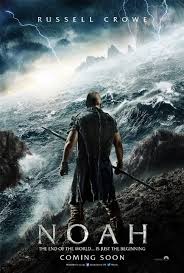
It has been a busy month for me but I have 4 things that I would love to hear your thoughts on in the next 24 hours.
I got a sneak peak of the new movie Noah and got to be a part of a roundtable with the director and screenwriter. You can listen to the HomeBrewed review of the movie and interview here.
Today I want to put up my two posts on Noah and see what y’all thought of it (if you got to see it this weekend).
______________________
The new Noah movie is a masterful work of biblical imagination and creativity. 
There are two aspects of the movie that audiences will notice up-front:
- one is related to epic-mythic-primal narrative
- the other addresses physics and logistics
The latter is significant for the former. Through a creative move to put the animals into hibernation, all of the questions about how you would feed that many animals, keep them from killing each other, and shoveling manure are instantly relieved. Those who are concerned about such logistical matter can then relax and settle into the narrative.
This is important because for many viewers, the story of Noah is either a) a children’s tale or b) a physics/apologetics problem.
What is missed in both the children’s story and the apologetics arguments is that we are dealing with an epic-mythic-primal narrative. It is not a newspaper account of the flood.
The danger of reducing epic-mythic-primal narrative down to newspaper reports is that too much is lost in the reductive move. The sad part is that often those who are the most series about the biblical account – and who may be upset about the creative flourishes in this movie – have often fallen victim to a debilitating loss of wonder and possibility.
This is a ‘Failure of Imagination’.
When the Biblical Narrative is reduced down to a newspaper report, the account lacks the appropriate level of animation.
Aronofsky illustrates how a story should inspire us. This is how we should entertain and engage a Biblical narrative – not by simplifying it down to a flannel board representation – but by breathing more life into it to see what emerges.
In the interview you will hear Aronofsky and Ari Handel say that they wanted to ‘humanize and dramatize’ this work of ‘primal story telling’. My mind went immediately to the work of Hans Frei – specifically The Eclipse of the Biblical Narrative. Frei was both concerned about and critical of the shifts that happened in recent centuries of biblical criticism. We had clearly moved out of the pre-modern (pre-critical) way of addressing a sacred text and into (via the enlightenment) a flood of critical thought and scholarly criticism.
Both the fundamentalist retreat to historical facts and the liberal abandonment of historical concerns are a failure to Frei. This is not about extracting universals or proving ‘facts.’ That is an exercise in missing the point.
Frie’s proposal related to fitting our world into the world of the Bible. While I don’t subscribe to Frie’s system wholesale, I think that he would be very impressed by Aranofsky’s vision for the Noah story.
The director lets us inhabit the enchanted world of Noah and tries to find elements of our world within it. This is the beautiful opportunity provided for us through film. We breath creativity and imagination into the text and let it come alive.*
The next post will look at ReEnchanting the world the Noah inhabited.
*It is important to note that Aronofsky and Handel took great pride in not contradicting a single detail in the biblical account. They admittedly added and embellished other aspects of the story.

It is fascinating what happens to conversations when you take away one word. Words are like little suitcases – people put understandings or concepts in them and then carry them around as self contained units. Its so easy! They come with these convenient little handles and you can you pack so much meaning in and mean so much when you just use one little word.

This can be especially dangerous in theological conversations. That one word can take paragraphs and pages to unpack. Sometimes it can be a very liberating experience to take a word off the table. Just say ‘if you can’t use that word, how would you talk about this?’ It is an amazing exercise.
A few weeks ago I had fun asking the question “what if you can’t use the word ‘demon’ – how would you talk about these same things?” I am suspicious that we who read the Gospels and New Testament don’t mean the same thing when we say ‘demon’ or ‘devil’ as those in 1st century region of the Mediterranean did.
So it was with great interest that I had an amazing conversation this past weekend with a group of very intelligent, but non-theological folks. We were talking about God and the subject of evil came up. What was fascinating is that I did not place restrictions on the conversation, it happened organically – they just don’t use the usual words! Never once did I hear
- Theodicy
- Omnipotent
- Kenosis
I started thinking “what if we had this conversation without those three words?” They are great words, and that is part of the problem! People assume that they know what is packed into the words and so they throw them around with ease (they come with convenient handles after all).
Here was my opening statement that sparked the debate:
God is doing all that God can do right now in the world. What you are looking at is the best that God can do. God is not holding back. God is doing God’s best to make the world a better place that more conforms to the divine will.
You can understand why that set off sparks. The questions, comments, and concerns started flowing. Is God more powerful than God lets on? Has God restricted Godself? Has God willingly emptied Godself of some of God’s power? Can God pick up that power anytime God will and God is just choosing not to?
There are specifically 3 groups that have shaped my thinking on this:
- The Kenotic Crowd – Multmaniacs mostly, but more generally people who think that God is who we have always said God to be but that some ‘emptying’ (see Philippians 2) or self-limitation has happened. God is ‘all powerful’ or ‘all mighty’ but has just chosen to act this way (free-will, etc.)
- The Process Perspective – Between Marjorie Suchocki, John Cobb, Catherine Keller, and Philip Clayton they have this thing covered. I thank God for Process as a conversation partner.
- The Caputo Contingent – with his book ‘The Weakness of God’ John Caputo shook some of us to our core and rocked our ‘foundation’. What if God’s strength was shown in weakness?
I have become very comfortable with the possibility that world as it exists is the best that God can do. I’m not saying that I believe that – just that I am open to that possibility.
What if God is doing all that God can do in the world right now?
What if God isn’t all-powerful but only very powerful?
Or that God’s power is a different kind of power?
What if God isn’t pretending or self-limiting?
What if God is giving all that God has to the moment?
So we don’t have to ask ‘why isn’t God stopping the genocide in Africa’. God can’t. It’s just not how it works. God is doing what God can but we are not cooperating.
Now, some will say “No, God could do more but has chosen to limit God’s self” or “God has emptied some of God’s power and given it to us as co-creators and free agents – we are misusing our power. It’s not on God.”
I just want to throw out the question “What if this is the best that God can do?” I am comfortable with that.
Looking forward to your thoughts! All I ask is that you try not to use ‘theodicy’, ‘kenosis’, or ‘omnipotent’ without unpacking them.
 Bo Sanders: Public Theology