Search

Bo Sanders: Public Theology

updating & innovating for today

Author

Bo Sanders

practical theology, religion & culture

Time for Church 2.0

Interactive Church is my passion.

This week we finally go all the way to Church 2.0 with my current congregation! We have been practicing the component parts and building a culture of conversational listening for 2 years. This Sunday we put it all together for the first time.

You can find videos for Interactive Church (2.0) here [link]

Each of our Sunday gatherings are conceived of in 3 Acts and each act is centered around something (usually involving a table).

Last week was:

  1. Coffee Table Conversations
  2. Sermon/Homily
  3. Communion Table

This week will be:

  1. Presentation of Seven Passions
  2. Coffee Table Conversations
  3. Comparing Notes ‘at the table’.

Here is a short (7 min) video about ‘putting it all together’ and why it is time for Church 2.0

Please let me know if you have any questions or clarifications

Why Use NT Wright?

This September we are going through both the Gospel of Luke (Sundays) and the book of Job (Wednesdays). I had pointed people to NT Wright’s Luke for Everyone as a resource for our study.

It was pointed out that NT Wright is conservative. While he is certainly more conservative than I am (and most at Progressive Bible Study), it does merit a look at why we would use his work as a launching off point.

The key is that many of our participants are ‘post-evangelical’ and so we are being careful to not ‘define ourselves by what we don’t believe’. It is a danger that many ‘exvangelicals’ and former evangelicals (and even post-christian folks) are more sure of what they don’t believe than what they do believe.

We are on a journey together and so NT Wright provides us a launching off point because he is the foremost popularizer of contemporary Biblical scholarship.

It is not enough to know how you don’t want to read the Bible but we want to provide something to start with about what a passage may mean before we run it through our ‘progressive lens’.

I take the concern about NT Wright seriously. I have been critical of his approach many times.

It is also why I always pair it with a more adventurous (and usually academic) resource. For Luke I have chosen “Mark & Luke in Poststructuralist Perspectives: Jesus Being to Write” by Moore. It is a wild look full of daring ideas.

Admittedly, it is not for everyone. It does, however, allow me to come around the back door and sneak in some alternative perspectives. I also use Postcolonial Bible Criticism by R. S. Sugirtharajah

I hope that helps to clarify my comfort with utilizing NT Wright’s ‘Everyone’ series.

Here is a quick video explanation

Not Everything Happens For A Reason

Romans 8:28 often gets translated “All things work together for the good of those who love God and are called according to God’s purpose.”

This idea has migrated into our culture, absent the God element, as “everything happens for a reason”.

Both the Bible version and it’s secular offspring have had disastrous ramifications. It is a dangerous idea that harms people daily.

Not only is it a bad reading of the scripture but its impact is devastating for people’s faith and lives.

In this sermon, I challenge the assumption by pointing out two simple things:

  • Not everything works for your good. Some ‘things are working against you.
  • There is an agent (God) that is at work in ‘all things – both good and bad.

We need to get this right because there is a better reading of that Bible passage.

Please let me know your thoughts, questions, and concerns.

Conferences: Problems & Limitations

Randy Woodley and Bo Sanders talk about some problems and limitations of conferences.
Concerns go beyond who talks or what they say – it is about how things are organized.

In the last decade issues of race, tokenism, representation, equality, and power dynamics have come front and center (literally).

Randy wants to promote indigenous models of learning. Bo wants to put the medium & the message in the spotlight.

Enjoy this short chat and let us know your thoughts.

Our next LIVE Online Chat is Sunday August 11 at 3pm (PST). Let us know you want an invite to the Zoom Chat by emailing Connect@PeacingItAllTogether.com

Nobody Reads The Bible Literally

Nobody reads the Bible literally. We are all interpreting – and this is a good thing!

This admission allows us to say:

Since we are all interpreting, let’s talk about how we are interpreting.

I first realized this about the book of Revelation (apocalyptic literature). Then it became clear about other genres of scripture like wisdom literature (like Job) and the gospels (like Luke).

Here is a recent sermon that I gave on the subject. You can also listen to the full version of it (including a lot of joking at the beginning) on the VHUMC podcast.

I would love to hear your thoughts, questions, and concerns.

I will be saying more about the idea of ‘moving your application up to your interpretation’ in the months to come.

Preaching Luke Together

I am doing an interesting experiment this Fall. A group of us are going to preach through the Gospel of Luke together by collaborating the sermon prep. Some of us will be in a room together in Portland and others will join via Skype.

I have always enjoyed collaborative projects and I really enjoy sermon prep so I am hoping that it is doubly enjoyable to combine them!

There are two wrinkles that I am looking forward to:

  1. We are saving the nativity story for Advent (December) so we will begin the series in September with Chapter 3 of the Gospel.
  2. One top of the NT Wright ‘Luke For Everyone”, each of us is reading a different commentary and then bringing that unique resource to the prep table.
The 2nd resource can be whatever you want. We will compare notes each month at the planning meeting. All the resources and planning materials will be uploaded to a website and dropbox.
 
I plan on using two resources – one for my congregation and one for my sermon prep. 
The one for the congregation will be Luke for Everyone by NT Wright 
The one for sermon prep will be much more adventurous and daring
 
My sermons will be triple-layered: 
  1. What did Luke’s original audience hear?
  2. What has this passage come to mean since then?
  3. What is the most that this text can mean in the 21st century? 
 
I want to introduce both the historical context AND the progressive trajectory of the gospel. 
The hope is to help people consider a grown up version of Jesus, not just the ‘Mr. Rogers with a beard‘ version from Kids Sunday School. 

Luke: Preaching Gospel

September

8th                    1:1-4                Intro: 4 Gospels 1 Jesus

15th                  3: 1-20             Voices in the Wilderness

22nd                 3: 21-38           Where did you come from?

29th                  4: 1-29             Trusting God – Rejected by Humans

October

6th                    4: 31-44           Healing Inside and Out

13th                  5: 1-11             Go Deep (Discipleship)

20th                  5:12-31            Restored and Repaired

27th                  5:33-6:11         Rules and Religion

November

3rd                              6:12-36            Raising Expectations

10th                           6:37-49            Compare and Contrast

17th                           7:1-17              Life is Tough

24th                           7: 18-50           Two Different Lives

December

1st                              1:5-45              Setting the Scene

8th                              1:46-80            Songs of Hope

15th                           2:2-20              Event Horizon

22nd                          2:22-40            Promises Seen

29th                           2: 41-52           House and Temple

January

5th                    8: 1-21             Growing and Belonging

12th                  8: 22-39           Power and Grace

19th                  8: 40-56           Daughters Restored

26th                  9: 1-23             Mid-Term Exam (now you try)


Bad Bible Reading

I am having so much fun this Summer challenging assumptions. Every Sunday morning we tackle a different difficult topic.

This past week was ‘bad readings of the Bible’, especially as they relate to God and hell.

We used Matthew 10:26-31 and the parallel passage in Luke 12.

Below is the YouTube link to the Vermont Hills’ page. You can also listen to the podcast audio if you prefer or watch it on FB.

Let me know your thoughts, comments, concerns, or questions

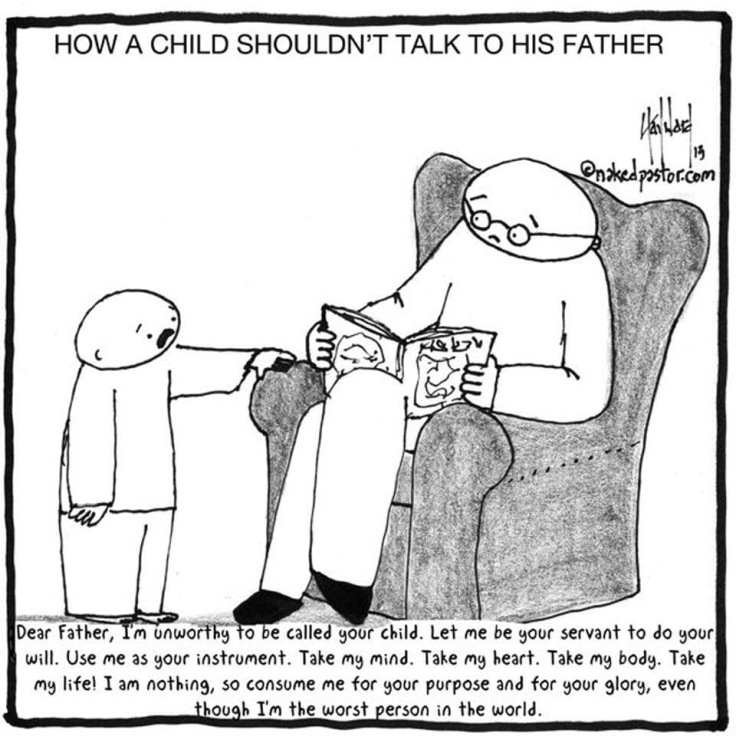
Daddy God

More than masculine imagery is needed for health and wholeness.

The divine – transcendent – eternal is so much more than the metaphors and analogies that we utilize is worship and prayer.

“The rule of prayer is the rule of faith” has migrated historically from prayer to sacrament to preaching and, now in our musical age, to worship. See also Worship Words Determine Faith [link]

Our language about God functions – Elizabeth Johnson

This is why we must both account for and attend to a more well-rounded and balanced approach to our imagery about God.

Please support the work of Naked Pastor

Watch this video and let me know your thoughts about my nuanced and constructive proposal.

Here is the comic from Naked Pastor

IMG_9905

Are Denomination (like Methodism) Antiques?

Not all antiques are created equal.

Some are just knick-knacks and mostly just ornamental or conversation starters.

Some are still useful and they come with a novelty factor.

Others need to be repurposed for some use other than their original one.

There even ‘reproductions’ that are designed take the best of the old model but which integrate new technology. These have been updated but in a way that still pays homage to the original purpose.

There are also antiques that don’t know that they are antiquated.

Denominations, like Methodism, are going through a challenging time. Their infrastructure and polity come from a European model leftover from State-Church models that prospered in Christendom. Even backlash movements (like early Methodism) become labored in legislation, politics, and governmental frameworks.

I am asking if they are ‘usable antiques’ or do they need to be repurposed. Are they able to be updated to include new innovation? Are they ornamental or can they be adapted in a way that still pays homage to the original design and vision.

Enjoy this video and let me know what you think.

Create a free website or blog at WordPress.com.

Up ↑