Search

Bo Sanders: Public Theology

updating & innovating for today

Author

Bo Sanders

practical theology, religion & culture

The Upside of Critical Theory for Christians

The Upside of Critical Theory

An interesting question came out of last week’s video in response to ‘why evangelicals can’t do critical theory’. when someone asked “what is the upside?”

This is a fantastic question. I would like to submit that there are 3 major benefits of CT

  • It breathes new life into a root bound plant.
  • It levels the playing field.
  • It reflects the methods and the model of Jesus.

It breathes new life into a root-bound plant.

Not everyone has been a part of a community, congregation, organization, or institutions that they really loved. If you have been a part of a collective endeavor that meant a lot to you, you will probably know that over time things can become a little too insular or set in their ways or self-referential or internally focused. Unfortunately, this is all to common.

Even significant movements can stagnate, codify, and begin to fall into the rut of maintenance mode. It happens to the best of them. Some (or most) of the energy that once went toward out toward the ‘mission’ or the ‘out-reach’ slowly shifts and becomes about preserving what we already have (or once were) and maintained the administrative or bureaucratic apparatus.

When structures begin to become too limited in their scope, or they leave behind their original passion or vision, it can be like a plant – to use an analogy – that has been left in the same pot for too long. The roots can not expand and begin to grow around upon themselves and the unhealth known as being ‘root-bound’ can happen over time.

Loving the institution, at that point, is being daring enough to undergo the arduous process of pulling the plant out of its pot and pressing your fingers or an instrument into the roots to break them apart and create some space of new life and growth.

This is why the ‘tool-box’or critical theory can actually be a good thing for organizations, C(niche) or too self-referential, exposing ideas that have become taken for granted, challenging systems, bylaws, protocols, regulations, committees and boards that insulated from review or accountability – critical examination can help loosen that which is bound by tradition, set in its ways, or insulated by power and influence.

Loving something means not giving up on it and just walking away sometimes. Doing the hard work critical analysis (or decolonizing perhaps) is a labor of love.

It levels the playing field.

Critical theory (and specifically critical race theory) can be great ways of examining issues related to access, recruitment, training, funding, and empowerment (to name a few). Critical theory is an approach that that brings many tools to a project. The goals are to examine, expose, and advocate – to change, not just explain, an area of need.

Those who practice critical theory have a loose collection of commitments and general set of approaches that roughly configure them as an ‘approach’. Critical theory isn’t so much a ‘thing’ as it is a specific commitment to address a ‘thing’. It has a asymmetrical relationship to power: It wants the power to investigate the power – and will shout, claw, and demonstrate in order to do so.

We all see the disparity and inequality that manifests in our culture historically  and currently threatens to pull apart our society. Critical theory starts will the realization (or conviction) that something is wrong with that level of disparity and inequality. Critical theory is concerned about the marginalized, the oppressed, and the left-behinds – the unheard, the under-represented, and the taken-for-granted.

Critical theory wants know the rules of the game, ask who wrote the rule book, interview those that uphold and reinforce the rules, examine the bank statements of those that profit from the game, explore possible bias (or preference) by those who facilitate the game, interrogate those who seeks to exploit the game, expose unjust practices and policies within the game, and advocate for change to benefit those who actually play the game.

One of the ways that CT does this is to expose ideology – that is: mental frameworks that are so entrenched and assumed that someone who holds them and acts on them may not even know that they are there or be able to articulate or explain them. Ideologies can manifest as beliefs, values, convictions, ideas, opinions, attitudes, rhetoric, prejudices, priorities, rules, laws, standards, regulations, moral codes (spoken or unspoken), motivations, practices, disciplines, rituals, ceremonies, polls, surveys, censuses, political activity, economic policies, legal matters, hiring practices, advertisements, financial investments, beauty standards, sexual permissions and so many other manifestations and expressions.

Ask yourself: What I am not allowed to question? What would I get in trouble of asking?  What would my community get angry about if I told our critics?

This will tease out the first thread of ideology. Is the fear that if you pull too hard on this thread that the whole thing unravel?

It reflects the methods and the model of Jesus.

Jesus both modeled and employed methods that would be very familiar to those who employ critical theory. As Randy and I say in our recent book [Decolonizing Evangelicalism]Jesus could be seen as doing a proto version of deconstruction. In both his teachings and his use of parables, Jesus models ‘asking the question behind the question’. Where did you hear that? What is their authority? Why do you think things are the way they are? Do you think that is the way that God wants them? Why do you think that person is your enemy? Can the ring of inclusion be expanded? What really ails you?

Jesus challenged the status quo. He interrogated the ‘as is’ nature of society and its institutions. He advocated for those were disadvantaged, neglected, marginalized, and discriminated against. Jesus exposed performative religion, calling out the motivations behind the posturing and practices of the temple system. He even demonstrated against injustice with violent force.

Admittedly, Reading the Gospels through a capitalist lens neutralizes much of this emphasis and gives us a much more sanitized and sterilized version of Jesus. That is why it is important to read decolonial perspectives because the gospels read very differently on the underside of history then they do when one is high in the hog– as they say. The Jesus of empire lacks most of this prophetic witness and critical impulse. That version of Jesus is much more therapeutic then messianic. A postcolonial or anti-imperial reading however highlights the proto critical theory modeled in the life, teaching, in ministry of Jesus.

Those are three of the benefits that a critical theory approach can bring to Christianity: it breathes new life into a root bound plant, it levels the playing field, it reflects the methods and the model of Jesus.

If you are interested in this topic, please check out my other posts:

The Beauty of Critical Theory

Critical Theory Will Be Our Salvation

Why Evangelicals Can’t Do Critical Race Theory

Follow Up to Evangelicals and Race

The Week In Review (early September)

The Summer lull is over and things are really picking up as we turn the corner toward Fall. I wanted to let you know about three of things you might be interested in.

It is not too late to join the learning cohort for the ABC’s of (modified) Theology. Our first discussion (A is for Atonement and B is for Baptism) is this Thursday at 3pm (PST). Sign up and join in!

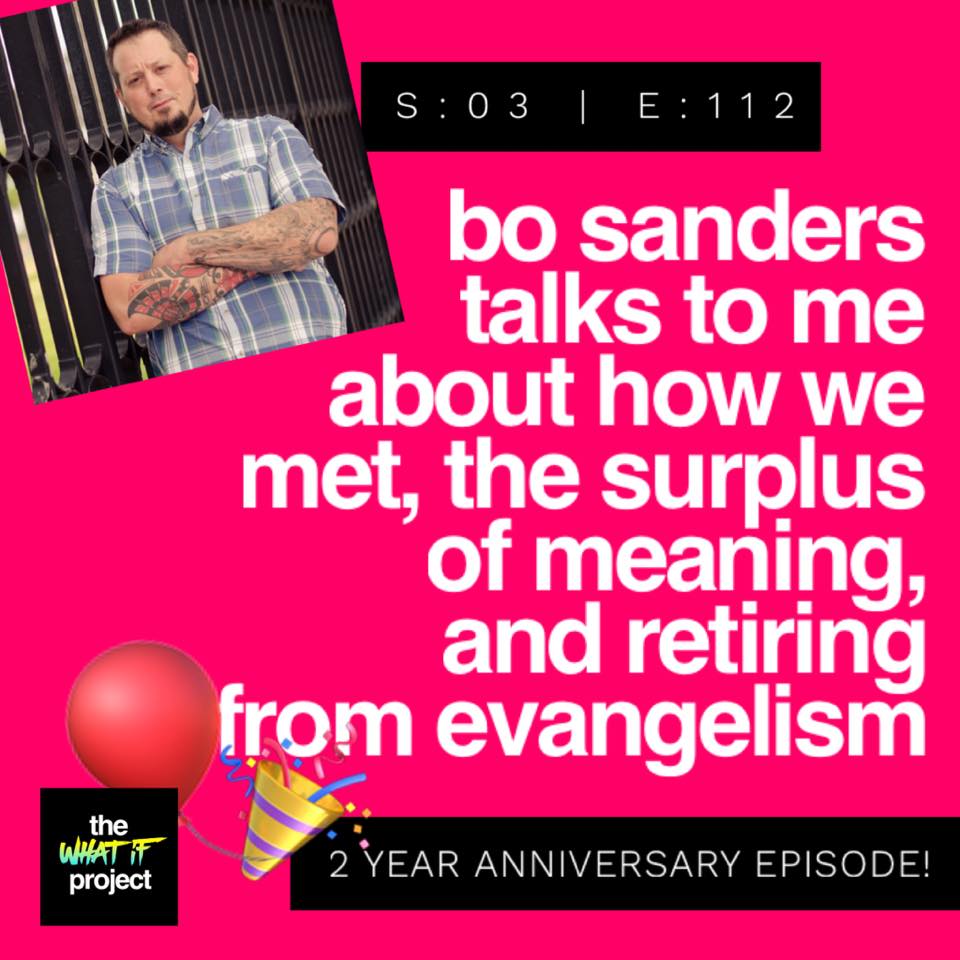
I was the guest on the What If Project podcast this past week.

APPLE – https://podcasts.apple.com/us/podcast/what-if-project/id1397047558#episodeGuid=whatifproject.podbean.com%2F235d0dfd-da93-3503-ab13-db844a7bcbcc

SPOTIFY – https://open.spotify.com/episode/3KkXpBNG5uTt7pqF5OAwk0?si=FCI9fdtKQ5S56FxruIO79g

PODBEAN: https://whatifproject.podbean.com/e/episode-112-bo-sanders-talks-to-me-about-how-we-met-the-surplus-of-meaning-and-leaving-evangelism/

Lastly, if you liked the sermon The Shape of Race, I would encourage to visit www.VermontHillsUMC.org  media page to subscribe to the YouTube and Podcast channels.

What If Bo

Thank you for all the support, feedback, and shares. It really helps to expand the conversation.

B is for Baptism (modified)

Baptism is up next in the ABC’s of (modified) Theology.

You can see the whole A-Z lineup and join the learning cohort that is forming this week [here].

Enjoy this 10 min overview video below. Read the PDF: B is for Baptism (modified)

Let me know your thoughts and your experience about the practice of baptism.

A is for Atonement (modified)

We begin our journey through the ABCs of (modified) Theology with A is for Atonement.

Here is the PDF: A is for Atonement (modified)

We touch on:

  1. Christus Victor
  2. Ransom Theory
  3. Penal Substitution (Satisfaction)
  4. Theosis
  5. Moral Exemplar
  6. Scapegoat

Enjoy this overview video. It is not too late to join! Go to the A-Z Overview and signup

Comment below and let me know your thoughts.

Response to Evangelicals and Race

I wanted to respond to the feedback I got on the video “Why Evangelicals Can’t Do Critical Race Theory”.

There were clear themes to the feedback in all 4 issues that I raised and to the thesis I proposed that Evangelicalism has become a set of conclusions.

  1. Individualism
  2. Scholarship
  3. Marxism
  4. Diversity
  5. Evangelicalism

Individualism: Why does it have to be an either/or issue. I am excited about this consensus. However, if you view of personal sin keeps you from addressing larger issues of systemic racism and structural injustice then it is a barrier.

Scholarship: I am thrilled that there are some PhD students and new faculty hires who engage in Critical Race Theory. I just hope that their insights will be received by the institutions when it comes to hiring practices and funding issues.

Marxism: It turns out the ‘cultural marxism’ is not just a boogeyman but a red herring. My suspicion is the it more about Foucault then about Marx. (Yes Foucault was a marxist for time). It is the legacy of discourse analysis and the genealogy of power that has disseminated into our entire culture in the 21st century.

Diversity: There was wide acknowledgement both of evangelicalism’s racial diversity (a good thing) and that it hides behind this diversity to not deal with other issues of justice such as LGBTQ inclusion and (for us more specifically) Critical Race Theory (CRT) in issues related to recruitment, funding, empowerment, and training.

Evangelicalism: Those who did not like my thesis that evangelicalism has become nothing more than a set of conclusions (or a constellation of convictions) could not provided a better definition of contemporary evangelicalism in N. America. My assertion that is has migrated to become a bounded set with heavily policed boundaries may not be a generous or broad as some may desire but until someone points to a clearer framework for understanding the changes in the evangelical movement over the past 50-70 years then my assertion has merit for consideration.

Let know your thought and we will keep the conversation going.

The Shape of Race

Race is a construct that configures us as humans.

This short sermon talks about how we are knit together as a society.

You can also download the free ‘Whiteness Workshop’ if you are interested.

Let me know if this was helpful or how I can make it better.

Why (modified) Theology?

Introduction to (modified) Theology

mod·i·fy.  /ˈmädəˌfī/

verb

  1. make partial or minor changes to (something), typically so as to improve it or to make it less extreme.
    • BIOLOGY

transform (a structure) from its original anatomical form during development or evolution.

  • GRAMMAR

(especially of an adjective) restrict or add to the sense of (a noun).


Our Contemporary Situation

We live in a rapidly changing world. In fact, it might be said that we have entered a new era where change is not just incremental and predicable, like it was in the past, but is now exponential and erratic – even random. The sheer amount and rapid rate of change has created a collective disorientation and what can feel like wide-spread chaos.

These changes affect almost every area of our lives, from technology to politics, and from the weather to real estate prices. In fact, it is almost impossible to think of anything that is not in the midst of rapid change. In this environment, some people hold up religion as the one thing that should be constant, dependable, and predictable. These people say things like, ‘God never changes,’ or ‘Jesus is the same yesterday today and forever,’ or ‘there is nothing new under the sun,’ and use these aphorisms as an excuse to not question inherited assumptions, doctrines, and dogmas.

The reality is, however, that religion – Christianity included – is experiencing a time of rapid change which is forcing an era of overlapping crisis, decline, anxiety, and adjustment. In her book “The Great Emergence,” Phyllis Tickle says that this is a fairly predictable 500-year cycle in human history. Society revisits its priorities and structures to correct the bad (or outmoded) and embrace or adapt to the new circumstances.

This can feel destabilizing, but I want you to consider that this might all be a good thing. The current environment of exponential change and perpetual transition may be a wonderful opportunity to do some much needed updating and innovating. Christianity in the 21st Century may need more than a minor tweak or some fine-tuning. This tradition that we have inherited may require some structural changes and a whole-hearted redress of some fundamental flaws. Acknowledging, accounting for, and attending to theological concepts from the past will be a major piece of our theological task in the 21st Century.

Why Modified Theology? 

One of the changes that is most notable in our era is the addition of modifiers to nearly every noun. The use of these phrases is not a secondary issue nor an incidental change. The evolution of our language to include so many of these modified nouns points to an important change in the structure of our society. Consider the fact that a modifier can so powerfully alter the anchor word or concept that it radically transforms the subject or changes the meaning entirely. Examples of powerful modifiers are everywhere:

  • Post-Modern
  • Social Media
  • Identity Politics
  • Organic Vegetables
  • Online Dating
  • Community Gardens
  • Emerging Leaders
  • Custom Countertops
  • Unisex Bathrooms
  • Global Markets
  • Democratic Socialism
  • Independent Bookstores
  • Asian Americans
  • Mega – Churches
  • Ex-vangelicals
  • Sub-discipline

Modifiers play an important role in our era because ours is an age of specialization. The upside of specialization is that many things can be customized, tailored, or retro-fitted to be more useful, appropriate, and productive. The downside is the trend toward fracturing, fragmenting, and division. The stress of this trend is evident in our politics, our families, our communities, and even in our denominations.

In the medical field, specialization has been embraced for the positive. We have moved from having generic doctors to having general practitioners and a plethora of specialists from proctologists to orthopedists, pediatricians to oncologists, obstetricians to optometrists, and surgeons to internists. We have benefitted from this specialization through having access to professionals with increased levels of expertise in whatever ails us.

In theology, on the other hand, specialization has been utilized to minimize and marginalize those who have traditionally been unrepresented or underrepresented. Whether feminist, black, decolonial, queer or any other number of perspectives, a modifier was applied to these minority theologies to label them as special interests and silo them into their own sidelined conversations.

Times are changing, however. Everyone is about to get modified. As I said in my recent book with Randy Woodley:

“In the new landscape, no one gets to claim a privileged place on tradition or legacy alone. Everyone gets modified and everyone has to explain what their project is all about. There are no free passes and no one gets to be “regular” or “normal.” We are all up to something, and we each take our turn qualifying our project and justifying our approach.”[1]

This is a positive development. No longer is there a ‘standard’ or ‘normal’ theology by which other theological perspectives must be measured. This legacy theology will itself be modified, as ‘traditional’ or ‘conservative’ or ‘establishment’ or ‘European’ or ‘complementarian.’

The addition of modifiers is not the only significant change today. You may have also noticed the multiplication of plurals. This is a noteworthy development because it is more than just adding an ‘s’ to the end of words. It is a recognition that there is multiplicity at work. It is an acknowledgement that our reality is inherently diverse and that, to be accurate and account for the complexity of most topics, a single view will not suffice.

You will notice modifiers are often used in conjunction with plurals when it comes to theological concepts. This is intentional as the fields and disciplines within theology are not only increasingly specialized but inherently diverse. The emergence of Feminist theologies, Postcolonial theologies, and Liberation theologies is a massive and extremely consequential development. It is in this combination of modifiers and plurals that the implicit is made explicit: that there is not just one stream of thought in these theological schools. They do not speak with one voice, they do not always agree, and they are not monocultural. There is not just one type of feminist theology or postcolonial theology or liberation theology. This is one of the best developments of the past 50 years!

The domino effect is that the entire discipline of theology is impacted. As I mentioned, what has been traditionally seen as standard in the field of theology must be modified as well. We must categorize these inherited approaches as Catholic theologies, 20th Century theologies, historic theologies, evangelical theologies, etc. This is more accurate and thus more illuminating. It is a wonderful and helpful development from which every discipline now benefits – even if they view it as an imposition and inconvenience. The rules of the game have changed and now everyone must play on a more level and inclusive field.

The Surplus of Meaning

Why do I like this development so much? I subscribe to a theory put forward by a thinker named Paul Ricoeur called “the surplus of meaning.” In any symbology as rich as that found in the Christian faith, there is bound to be an overflow of meanings and interpretations. Think of the richness of the sacraments, full of imagery, ritual, and ceremony. There is no single understanding of something like the Lord’s Supper that explains or contains its full meaning. That can be seen just in the sheer number of different names it is called. There are layers of meaning that get to different facets of the sacrament when it is called the Table of the Lord, Communion, Eucharist, or Mass. There is an overflow of possibilities and a multiplicity of interpretations and applications. Theological concepts are layered in complexity and richness. We cannot hope to explain or illuminate them with overly simplified or one-dimensional understandings.

More on this in PDF : ABCs (modified) Introduction

Moving Forward

From the very first chapter of this book, A is for Atonement, you will see my conviction that we must recognize and celebrate the multifaceted nature of our theological concepts in order to even begin to understand their full richness. I start by exploring the five most prominent views of the atonement that have developed in history, acknowledging the complex nature of the topic. Then, as with most topics we will cover, I highlight a contemporary view that seems to deal with the flaws of the historic understandings. The ‘surplus of meaning’ approach allows me appreciate what the traditional understandings were attempting to do while celebrating the multifaceted, complex, tiered, and layered texture of the topic. Atonement is the perfect place to begin because, unlike so many other subjects, neither the Bible nor the creeds have taken a clear stance on ‘the’ right way to view it.

Then, as with all of the chapters, I explore another word that begins with the featured letter (adiaphora in this case) that both compliments and ties into the main concept of the chapter. Sometimes the complimentary word will get as much attention as the title topic. My hope in pairing these concepts is to give you new strategies for cultivating a theological understanding that is fertile and fruitful for your life of faith and your community in this new landscape that we find ourselves in. The world has changed and is rapidly changing. Our theological understandings cry out for updating and innovation.

People are fond of the saying “the more things change, the more they stay the same.” That saying has never been less true than it is today. Now, it may be more accurate to say, “the more things change the more momentum they pick up and the more they seem likely to keep changing.” I am delighted that you have decided to join me on this journey of grappling with and celebrating these changes. I hope that you will find these chapters to be a helpful resource for your theological project and understanding. After 12 years of blogging and podcasting with this approach, I know that it can be challenging, disorienting, empowering and even liberating all at the same time.

If you find yourself discouraged, lonely, or afraid of where this road leads, please do not hesitate to reach out to me via email or social media. I also invite you to join the online community that will be formed around this book. It will be a good place for conversation, clarification, and comradery on this journey.

Sign up for the learning cohort that starts next week on the ABCs of (modified) Theology

[1] Decolonizing Evangelicalism: An 11:59 pm Conversation. p 48

A-Z in (modified) Theology

In just a couple of weeks we begin the journey through the ABC’s of (modified) Theology!

The schedule is below this intro video.

Mondays at 4 and Thursdays at 3 pm (PST)

Aug 24 & 27

Why modified theology and our contemporary situation

Aug 31 & Sept 3

A is for Atonement (also Adiaphora and Apophatic)

B is for Baptism (and the Body) more than a metaphor

Sept 10

C is for Christology  (and Constructive Theology )

D is for Deconstruction  (and Death of God)

Sept 17

E is for Empire (and Evangelical)

F is for Fideism (and Feminist)

Sept 24

G is for Genre (and Globalization)

H is for Hermeneutics (also Heaven and Hell)

Oct 1

I is for Infallible, Inerrant, & Inspired

J is for Justification (and Justice)

Oct 8

K is for Kenosis (and the Kingdom)

L is for Liberation (and Logos)

Oct 15

M is for Metaphor (and Metaphysics)

N is for Neoplatonism (and Narrative)

Oct 22

O is for Open & Relational (and Orthodox)

P is for Perichoresis (and Post-Colonial)

Oct 29

Q is for Quest for the Historical Jesus (and Queer Theology)

R is for Revelation (and words that begin with ‘Re’)

Nov 5

S is for Salvation (and Second Naivete)

T is for Theopoetics (and Technology)

Nov 12

U is for Universalism (and Ultimate Concern)

V is for Vatican II (and Voluntarism)

Nov 19

W is for the Word of God (and the Wesleyan Quad)

X is for X-ray (and Xenophobia)

Nov 26

Y is for Y2K (and Youth Ministry)

Z is for Zebra (and Zionism)

How To Get Involved: You can either email anEverydayTheology@gmail.com or let me know on the Public Theology FB page that you want to be a part of it and you are in.

Now – If you can give $13 dollars – $1 for each week  or $26 – one for each letter of the alphabet or whatever you can do, that would be great.  If not, don’t worry about it – I want everyone who is interested to be involved in this conversation.

Patreon: https://www.patreon.com/BoSanders

Paypal: bocsanders@gmail.com

Venmo: @Bo-Sanders-4

Please comment below or email with any questions or clarifications that are needed.
I hope that you will consider coming on this journey with me.

Art by Jessi Turri

The Beauty of Critical Theory

I want to tell you about the beautiful side of critical theory– And specifically critical race theory (CRT) for me–as it relates to whiteness work and my religious faith.

Critical Race Theory (CRT) seeks to:

  • Examine
  • Explicate
  • Advocate

Another ways to say it might be that Critical Theory seeks to Interrogate, Expose, and Change – not just explain – culture and society.

Before I get into the beauty of all of that, some back ground. A couple of weeks ago I talked about Critical Theory being our salvation from bad religion, then why Evangelicals can’t do critical theory. I got so much feedback and am now getting some really interesting articles sent to me. It is a conversation that I love and am delighted to be a part of.

One pushback I got was about my calling Critical Theory a ‘toolbox’ and not a worldview. One insightful person pointed out that while I was technically correct, that Critical Theory does have an agenda and is not simply a set of tools.

So let’s be clear. Critical Theory – and Critical Race Theory – does have an agenda. I have summarized it in these three movements or motivations.

Examine or Interrogate

This ties into parables and prophets. Check out “Lessons from Luke”

Expose or Un-Mask

Both Walter Wink’s the Powers That Be and Girard’s Scapegoat theory of atonement tie in here. Ideology is another way of talking about the impulse.

Advocate or Change

It is significant to understand that critical theories are not just theories. Most are concerned with changing the phenomenon being examined not just writing it up as a case-study or deconstructing it. Deconstruction is fine (and essential)but not enough in the end.

The funny thing is that I know Critical Theory is not for everyone. I am not asking everyone to do it – but I am shocked and the number of religious people speaking against it!  So I need to say be careful of anyone who wants to preserve or conserve a notion of the past rooted in the 3 C’s :

  1. Constantine
  2. Christendom
  3. Colonialism

Please let me know your thoughts or questions.

Create a free website or blog at WordPress.com.

Up ↑