Search

Bo Sanders: Public Theology

updating & innovating for today

What I Learned (Education)

Last year was an amazing year of being a professor and meeting some incredible students. It was also an eye-opening year of getting initiated to a changing educational landscape.

In June 2016, I learned that there was an immediate opening at the seminary I had attended from 2008-2010.  I got the one-year appointment and left LA, where I was finishing up a PhD, to move back to Portland.

It was a wonderful opportunity and I loved being in the classroom for a year.

I also got to teach an ongoing ‘intensive’ class in a doctoral program on the east coast at a school that I have a long-standing relationship with. We decided to open up the class to MDiv (divinity) students as well as the Dmin (ministry) students.

There were some issues that stuck out to me and I took the opportunity to call my friends around the country who have tenure-track positions or who teach adjunct. They confirmed my observations. This was especially true at ‘christian’ universities (but not exclusively).

Here are my three observations about education:

  1. Money is the lead dog – but technology is dominant.
  2. Education is a product and students are customers.
  3. Professors are nervous.


Money is the lead dog – but technology is dominant.  There is a delicate balance between ‘being profitable’ and ‘making a profit’. The margins at many schools are thin and shrinking. Both the thin margins and the shrinking profits create a very intense atmosphere of evaluation, insecurity, anxiety, and demand.

Adding to this mix are Presidents and Deans who have to do fundraising with donors who also have expectations of message and image. Students have expectations of cost-value, the ability to complete a degree, and the outlook for using the degree in the future.

Tech is also playing a larger role. Between online-hybrid classes, student portals for the curriculum, peer learning in online class assignments like message boards, and in-class audio/visual … professors have to be tech-savvy and surprisingly structured.

When you put together the institutional fundraising concerns of donors and boards, financial and time justification for students, and technological innovations embedded at every level – you get quite a demanding matrix of issues to navigate.

You can understand why faculty meetings might be contentious or there might be tension between departments. You can also see why administrators are both so crucial and so influential. Watching over the ‘big-picture’ is no piece of cake either.


Education is a product and students are customers. That might sound cynical but if you have not been around education in the past decade, you might be surprised at how influence students have now and much weight they carry. This was perhaps the biggest change I noticed from 2008 as a student and 2016 as a professor.

Due to the financial concerns listed above, and the democratization that technology empowers in any population, the scales within a school have really shifted. Students’ voices carry a surprising amount of weight.

Think about it this way: if a student is unhappy they will take their business elsewhere. If the degree is too long (too many credits), too expensive, there is too much work in class, or they get a bad grade / have a bad experience … it doesn’t matter why they choose another school, it only matters that you are losing students. So, you adjust the curriculum, adjust the degrees, adjust the cost, and adjust the ease of access/living/travel.

In our contemporary environment, student representatives and liaisons are vital and very influential. Institutions, both faculty and administration, make many of their decisions based on student input. Professors may have to adjust assignments, schedules, reading loads, and grading scales accordingly.  I’m not saying that the students are in charge! I’m saying that it is a very symbiotic relationship.

Professors are nervous. Professors don’t get paid a lot but are expected to do quite a bit of work. It is a prestige thing, to be sure, but it is also a passion thing. Young professors are expected to go above-and-beyond to show their value to the institution. Older professors know that tenure doesn’t mean what it used to.

So, you can’t afford to get a bad review by a student. You also need to keep in mind the ‘mission’ of the school and the concerns of the older generation of donors and board members. You want to be proficient and competent enough to justify your work to the institution but not so innovative as to attract unwanted attention.

Then there is the LGBTQ issue. I will say more about this tomorrow, but it is important to understand that every ministry training institution that I interact with (6 in total in California, Oregon, and NY) is wrestling with this. Navigating between student enrollment, alumni, donors, and denominational leadership / funding is a tricky dance.


When you look at just these three observations – between salary, job security, ethical convictions, student expectations, and a shrinking number of full time positions … I learned a lot this year and am very grateful for the opportunity to be in the classroom and meet some amazing students!

I would love to hear your observations, comments, or questions.  

What I learned (social media)

The following reflections will not seem original or even insightful. They are just 4 things that I learned in my year off of social media that I would love to compare notes about.

In July 2016 I found out that I got a 1 year appointment to teach theology at a seminary in Portland. I would be applying for several permanent positions, so I decided to go quiet on social media. This was both to focus and to be safe with any of my possible employers.

Facebook cannot get you a job … but it can cost you a job. This is especially true at Christian schools.

I picked a good year to be off. It was an election year and both my students and my fellow faculty let me know that I was wise to get off when I did.

In August 2017, I returned and I noticed 4 really clear things:

  • It is really addictive.
  • Things have really changed in the past 3 years.
  • Twitter is nearly unrecognizable.
  • Volume is at 11.

 It is really addictive. I was shocked, that as an adult who knows better and has a good amount of self-control, how often I wanted to log in. I went a whole year without thinking about it or looking at it even once, but now 4-10 times a day I wanted to look.

I’m never on for more than 2 or 3 minutes at a time but I can see how people lose whole hours and evenings to it. It is a rare mix of intoxicating and unsatisfying at the same time.

That being said, I really enjoy seeing pictures of old friends and connecting with people across the miles. I really did miss it.

Things have really changed in the past 3 years. In 2016 I was still a co-host on a popular podcast and website. My online engagement was really extensive and very intense. In 2018 I no longer have a large platform and have really noticed how difficult things can be.

This will seem overly simplistic but it really seems that anything you put out there now is going to get 1 of 3 (and only 3) responses:

  • Crickets
  • Snark
  • Endless circular debate

Silence, snark, or heated yelling. I understand why people are getting tired, frazzled, and even giving it up. Personally, I love being part of the larger conversation and I really miss the broad appeal of a big platform, but I can understand why some people shrink down their circle to just those they know as friends and family.

The atmosphere has gotten quite contentious – and the intensity has become more amped-up.

Twitter is nearly unrecognizable. Facebook and Twitter have completely switched for me. I used to love Twitter and think that Facebook was too preachy. I now find comfort in Facebook being actual people I know, it is safer. Twitter has become a very aggressive and critical place. It seems uniquely built for outrage.

Now, in fairness, there are many things to be outraged at and critical of. I applaud that. My only point is that Twitter used to be more of a fun and flippant place. It is no longer like that. I actually tell church leaders and seminary students that if you are not already on Twitter, don’t start.

I still like both Twitter and Facebook, my point is that they have flipped functions for me.

The volume is at 11 and surges every 3 or 4 days. You really notice this when you have something thoughtful to share and just as your about to post it there is another:

  • Mass shooting
  • Police assault
  • Bomb attack
  • White House scandal
  • Trump tweet
  • Weather storm
  • Famous person exposed or fired

So you decide to wait a couple of days until the frantic calms down. Then 3 or 4 days later something else goes wrong. Repeat this cycle for 3 to 6 weeks and you realize you might be waiting a while. So you just go ahead and post it. It gets 1 like, no shares, and no comments.

A thoughtful, measured, and temperate post struggles to get a hearing when things are this loud and this agitated. I really do wonder if a generous and irenic approach is just invisible in this atmosphere. To be clear: I don’t plan on changing … I might need to adjust my expectations.


I would love to hear about your experience.
Have you ever taken a break from social media?
Do you ‘sabbath’ from time to time?
Have you noticed the same changes I have?


What I Learned (My Year Away)

I left LA over a year and a half ago. I left the internet for a year to focus on getting a permanent job. I came back to social media after the year was over but have only recently started blogging and posting videos again.

I am in a new city (Portland), in a new denomination (UMC), and in a new position (solo pastor).

Last year, I taught in 2 evangelical seminaries and attended a different church most weekends. I learned a lot through this process and next week I wanted to share some insights for your consideration. I will post 3 topics next week:

  • What I learned about social media.
  • What I learned about education.
  • What I learned about evangelicals.


Social Media:

Things have really changed in the past 3 years.

Twitter is nearly unrecognizable.

Social media volume is at 11 and surges every 3-4 days.


Education:

Money is the lead dog – but technology is dominant.

Education is a product and students are customers.

Professors are nervous.


Evangelicals:

They are really into the Bible.

They use coded language.

LGBTQ issues both terrify and annoy them.

They can smell danger.

They don’t get Critical Theory even a little bit.


I am really looking forward to this mini-series. Let me know if there are any other topics I should reflect on.

Y is for Y2K

Is the way that the world runs today the way that is has to be?
What would it take for the world to work a different way?
Can you imagine something better than democracy or an economic system after capitalism?
Is society in its final form?

[We are nearing the end of the ABCs of Faith in Sunday School . Listen to previous discussions here]  Expanded PDF : Y is for Y2K (preview)


From 1991-2003, I was taught to read the Bible in one hand and the newspaper in the other – I no longer believe that.

In my short lifetime I have seen so many predictions come and go. I have seen layers and layers of moving onto the next thing a passage means without even acknowledging that 6 months ago we were told it was something different.

I just had a talk this weekend with a denomination leader about how end-times expectations have changed in their lifetime. We talked about young leaders and how different their eschatology is from 50 years ago.

My hope for the next 3 decades is that sincere people of faith get fatigued on this unfulfillingway to read the Bible and this next generation is released and empowered with an understanding of genre that does not leave them susceptible and vulnerable to panic over sensations like y2k and franchises like Left Behind.

The world is in too great a need for really great people to be distracted by thinking that apocalyptic is A) predictive and B) about the 21st century.

Here we have 2 crippling problems to confront – and the problem is that they compound the effect of each other intensely.

The more minor problem is the one that we have touched on above: a loss of the prophetic or our Christian imagination.

The major, and more hideous problem, is something called “final forms”. We live in an era where systems have become so solidified, concrete, and assumed that are assumed to be ends in themselves.

  • Capitalism is the pinnacle economic system.
  • Democracy, while flawed, is superior to all others.
  • Nationalism will never be topped or undone.

They are final forms that, once invented or introduced, are here to stay.

And there is an ominous implication:

  • Christianity is purported to be in its final form.

The faith we have today cannot be reexamined, tinkered with, or questioned. It is written in stone and unchanging.

In fact, it gets worse – true Christianity was found in the early church and the answer to our current problems is to get ‘back’ to that kind of a faith – sort of a ‘make religion great again’ mentality.


Come this Sunday at 9 to hear the rest …   Art for the series by Jesse Turri


Measuring Ministry

We know that the way we measure ‘success’ as church leaders is not an accurate way to address actual ministry.

The old line about ‘nickels and noses’ doesn’t tell us if we are actually doing God’s work in the world or meeting our communities’ needs.

It also doesn’t tell the story behind the number … there is no room for narrative.

So I have come up with a different metric that I want to propose.

Moving on from Nickels and Noses to:

  • Hands
  • Feet
  • Mouths
  • Eyes
  • Ears

Hands – how many people did we touch?

Feet – how many people came across our property?

Mouths – how many people did we help feed?

Eyes – how many people saw our us? Street fairs, facebook, youtube.

Ears – how many people listened to the podcast?


The advantage to this new approach is 3 fold:

  1. It incorporates a ‘body’ metaphor that is both biblical and ‘incarnational’
  2. It makes space for narrative – the story behind the number
  3. There is a qualitative as well as quantitative element

Here is a short (3 min) video – let me know what you would add or change to this approach.

Guess What I’m Teaching On?

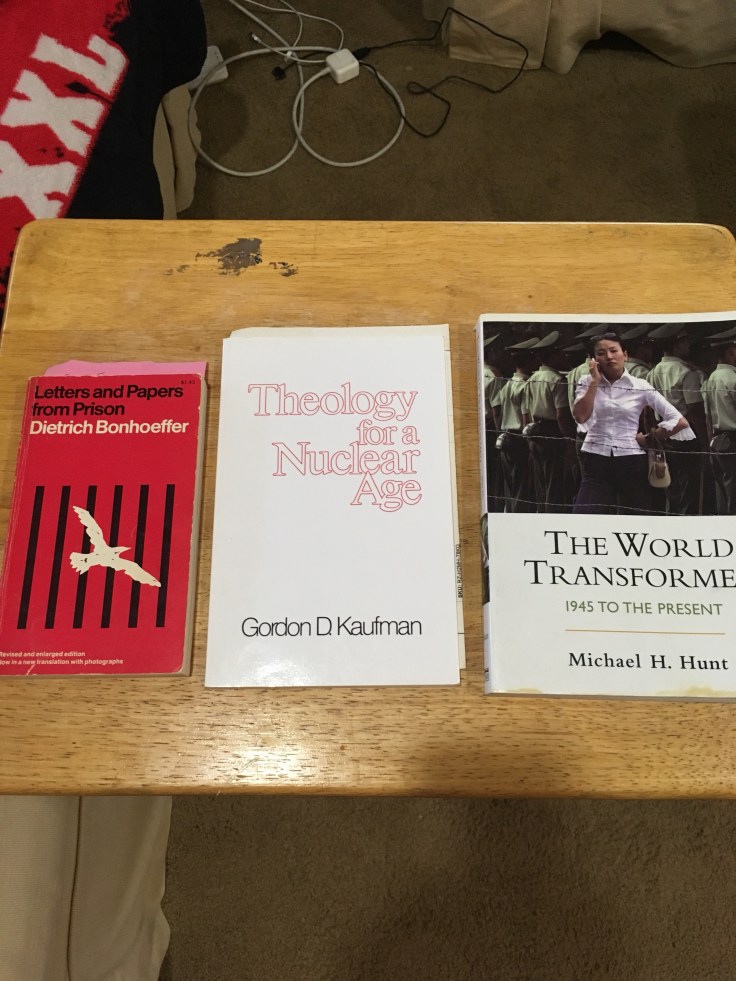
These are the prep books for tomorrow- guess what the topic is

Embodied Wisdom Enacted Knowledge

You have a wisdom deep inside of you that you might not even know how to access.

I want to introduce (or remind) you to an amazing concept: phronesis

Here is a ‘7 min sermon’ on the idea and a short explanation below.

I love this concept so much.

An interesting way to access it is by using the famous formulation of:

  • known knowns (things we know that we know)
  • known unknowns (things we know that we don’t know)
  • unknown unknowns (things we don’t know that we don’t know)

Then Zizek reminds us that the 4th quadrant would be “unknown knowns”!!

There are things that we don’t even know that we know … and this is why we need to know about phronesis.

Another way of approaching the idea is to focus on the kind of knowledge that is produced:

  • phronesis (practical wisdom) in contrast to the modern fascination with
  • theoria (theoretical knowledge and thinking) or
  • techne (technical knowledge and thinking)

A helpful analogy can be found in learning to play a musical instrument:

“Playing the flute, Aristotle observes, has value and fulfills its purpose well before the music stops. This is especially the case with ethical conduct and political activity, an ongoing process of deliberation that requires practical wisdom (phronesis). In contrast, (he) viewed building a house as poiesis— satisfactory only when the construction process is complete.” [1]

Unfortunately, after Aristotle poiesis got subsumed into praxis and was reduced into the binary that we have inherited today in the classic split between theory and practice. The final, and perhaps most popular, of these concepts is habitus.

The habits of faith form a character in you through repetition and spiritual practice.

You have a wisdom down inside of you.
It operates on a lower register than your immediate thoughts.
It is not just head knowledge.
It is deep inside of you – down in your bones.
Learn to trust your gut and follow your heart.

[1] Cahalan and Mikoski, Opening the Field of Practical Theology, 305.

Church Survey Responses

Earlier this month I responded to a survey being done by a grad student about new worship communities and churches in revitalization.

Below are some of my responses to the 3 questions – and here is a 10 min video with some pictures spliced for illustration.

1.What innovative practices set your faith community apart?

Vermont Hills UMC is attempting a hybrid expression that combines two very different ecclesial and liturgical formats. We have been a classic mainline worship format for our 50 years of existence. We never went through the ‘blended worship’ wars in the 1980’s and 90’s. We never had a worship band or song leader. It is just piano, occasionally organ, and a choir. We use singable hymns so that the singing is robust and fills the space with sound.

We have now added a coffee shop/living room feel that splices in conversation and a TedTalk style homily early in the gathering. Also, instead of the sermon, a different person (or persons) comes to a high-top table and has a conversation. Sometimes it is about the homily, or the passage of scripture – other times it is about an outside topic (such a non-profit that we support). This serves to ‘decenter’ the sermon so that our gatherings are centered around conversation.

Another innovation is that each time we do communion on the first Sunday of the month, we try something different. The two most recent communion weeks, for instance, were vastly different than each other.  In January, we set up 6 round tables in the corners of the sanctuary (we have an odd shaped space) and had 8-10 people at each table. They served each other communion with a prepared litany, and commune together for the rest of the service. In February, we set up different stations – a baptismal font, a table full of prayer candles, etc. – and had them wander around the space doing different activities before they went to the communion station. A 6-minute video played on the screen for those who did not want to wander.

2. How does your faith community meet people where they are, literally and figuratively?

I have developed an ecclesiology called Church 2.0 where we provide the space but not all of the content. The conversations during our gatherings are unscripted so that people can bring their concerns and insights.

Another aspect of our service to the community is the many non-profits we participate in and support financially. In January and February, we have had a different ministry or group ‘come to the table’ and tell us about what they do and how we can get involved. This includes our backpack ministry that packs food for kids at the elementary school next door who would not have food on the weekend, and Neighborhood house that helps families get back on their feet. We have 7 or 8 of these ministries that we support and participate in.

3. How does your faith community develop and equip young leaders? eg internships, pastoral residencies for young clergy, intentional communities?

I have only  been here 7 months but we already have a young minister going through the ordination process and several seminarians who help teach and lead. The format of ‘the table’ allows multiple voices to heard. Depending on the topic, they can help teach Sunday school, mid-week Bible study, ‘preach’ the homily, and be the liturgist as well. This gives them lots of opportunities to participate and practice. We will be developing a ministry team in 2018 for formalize this process.

Dialogue across the table is the key though. It is a platform that allows their voice to be elevated and broadcast. It is shared influence instead of one persons talking for 20-30 minutes week after week.

Billy Graham: Case Study

Graham’s life show us so much about the changes in our society and the church: from newspapers, TV, civil rights, evangelicals, politics, media, and so much more.

I was moving into my new office and purging some old files. I found a magazine (Promise Keepers) from 1997 that had Graham on the cover.

Here are some of my thoughts in this short video.


I would love to hear your thoughts, questions, and concerns.

Blog at WordPress.com.

Up ↑