Search

Bo Sanders: Public Theology

updating & innovating for today

Category

Books

Getting Ready For Reza

I am getting very excited about Reza Aslan’s visit to Homebrewed Christianity this September 3rd. In anticipation of this conversation, I am reading his book Zealot and I recently attended a conversation between Reza and Rainn Wilson (who you probably know as Dwight from the Office) that was hosted at Barry Taylor’s church. IMG_2395

All of that aside, I am a little confused at some of the negative press that Reza has been getting in the past weeks. I get that some outlets and camps will be perpetually perturbed, and I don’t worry about them.

What has drawn my attention is the push-back from those I know and follow who have seemed to raise the ire about both Reza and his latest project. 

The complaints seem to come in 3 broad categories.

  • This has all been said before / Why do we need another book about Jesus? 

I am mystified by this line of reasoning. You think that because the Jesus Seminar or Borg or Crossan, Horsely or Karen Armstrong has covered this (at least some of it) in the work that there is nothing new or no new presentation that could be helpful for furthering the conversation?

Clearly – as you can see from the media response – hearing this from a new voice or from a different perspective has hit a nerve of some kind.

  • He is not even in Biblical Scholarship. 

This is an odd criticism. He is a historian and if you look at the courses in his department at the UC Riverside department you will see that it is not your normal creative writing program. Plus, discounting an author because of their field/title within the academy seems like a last-ditch effort at some level.

  • The Islamic thing. 

Don’t even get me started. If only people within a tradition are allowed … so Christians are not allowed to research-write about Jewish history or address anything Islamic? This just doesn’t hold up.

Enough of the negativity. Let me get to 3 things that I like about Reza’s project.

  • I love his approach. 

Instead of starting with the Bible, he starts with history. The Roman world was well documented and allows us to gain an elaborate picture of what life looked like during that period. We even know about their agricultural practices and prices – not to mention military, political, construction, trade, and religious matters.

Then what he does is come back to the Bible to if the details in the Gospel accounts stands up in relation to what we already know. The advantage to doing this is it helps illuminate what aspects of the Gospels were written for theological reasons. I find this a very helpful approach.

  • Not everyone knows about synoptic studies.

I come from an evangelical world where people spend lots of time reading the Bible but may not know that much about the Bible. In fact, every Christmas and Easter I felt like the bad guy for introducing them to the differences between the Synoptic accounts (not to mention the Gospel of John being its own thing).

This is why I love that Reza is getting so much attention and that we will get to chat with him on September 3 … and at my home church of all places!

I am a confessional christian and take great joy in integrating contemporary biblical scholarship as much as possible. The trick is always taking the often critical stance of that scholarship and utilizing it is a constructive confession!

One way I have found success in doing this is to embrace that the Gospel accounts are theological presentations – not newspaper reports – and that in those details that appear to be non-historical the authors/communities that wrote them are trying to tell us something. I want to hear and proclaim that something.

Am I worry that Reza’s work might not be intended for that purpose? No. That is why we are in dialogue with those in different disciples and traditions. We are translators at some level – all of us.

We engage, absorb, adapt, adopt, appropriate and integrate to the best of our ability.

  • Liberals should be even more upset than Conservatives and Evangelicals.

I get why folks from the conservative and evangelical branches of the family might not be too keen on Raza’s project. It gives them whiplash if they have never thought about this stuff before.

The most ridiculous response, however, is when those from the liberal side of the fences take the ‘we have heard all of this stuff before’ stance. Listen to what he is saying:

If the only thing that you knew about Jesus is that he was crucified, you would know everything that you need to. Crucifixion is reserved from state-criminals. Jesus was convicted of sedition.

From there it gets zesty. It turns out that the criminals on either side of Jesus that day were not ‘thieves’ they were bandits. That is how the original greek word should be translated according to Reza.

Jesus was not a good little Jewish boy who unfortunately and surprisingly got tacked up on a cross. He was a political threat with radical stances that were dangerous to the establishment. So when Liberals shrug their shoulders and go back to being ‘Chaplains to the Empire’ and participating in the establishment in ways that are complicit in unjust and oppressive institutions … they have missed what Reza is saying about their ‘savior’. It is an indictment on a brand of christianity is that is so compromised and complicit with the system that it is has lost its prophetic unction and revolutionary subversiveness.

I am excited to read the rest of this book and to continue to get ready for the September 3rd event. I don’t want to miss the opportunity to hear about Jesus from an angle I normally wouldn’t encounter. If people want to quibble about the title of the book as being fantastical and over-the-top in order to gains sales … OK.  But let’s not miss the point of the project over the title.

I would love to hear your thoughts or concerns. 
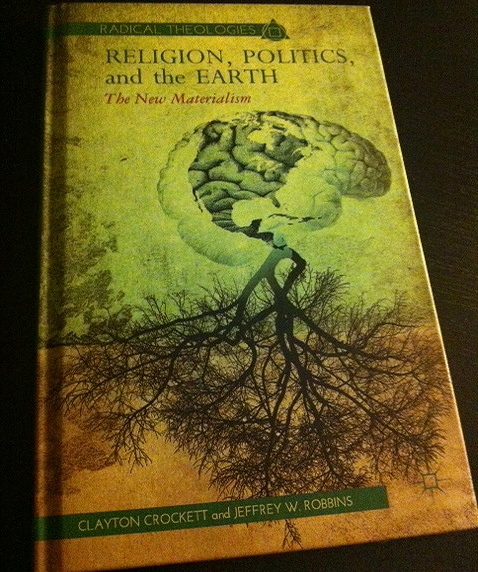
1st Chapters of Books: The New Materialism

I can not tell you how often I start a book and find myself thinking “This is going to be great!” ContentImage-63-220729-ContentImage63163974CrockettRobbins2

It doesn’t always turn out to be great… but there is almost always something in the 1st chapter that I would love to quote/riff on/incorporate.  The problem is that the rest of the book may not be very good OR it may turn into something that I am not sure I want to associate with/defend later.

I’m reading a book entitled “What Color Is Your God: Multicultural Education In The Church” right now. The subtitle is ‘examine Christ and culture in light of the changing face of the church”. The first chapter has some rockin’ quotes but I am nervous about the trajectory that the authors have set for the book.

I have also started an in-depth reading of “Religion, Politics, and the Earth – The New Materialism” by Clayton Crockett & Jeffrey W. Robbins. I have skimmed the book in prep for a series of HomeBrewed Christianity podcasts on the subject but this time I am prepping for a reading group that starts next week.

I have been thinking for a while about sharing great quotes that I find here. My hesitation is that someone will get nit-picky about not having the whole context for the content … but I think that I am just going to do it anyway.

So without further ado, here is a challenging quote from the beginning of that Crockett and Robbins book:

We are witnessing the exhaustion of contemporary culture, a devolution to consumerism, greed, mindless entertainment, and the corrupt appeal of money and military power. We encounter numerous scenarios of apocalyptic crisis and collapse both in the popular imagination and in the real world. Globally—culturally and economically—our world has become tied together to an unbelievable extent, just to the point where it is fraying and fragmenting apart.
Witness the vapidity of most popular cultural modes: the saturation of consciousness by “reality” shows, recycled commercial jingles and right-wing talk radio, and the bleeding of news into cynical infotain-ment, the dumbing-down or corporatization of education and other phenomena.3 The most invigorating buzz is usually tied to a sporting event or an advertising campaign.

I’m going to try this over the next month as a fun experiment – sharing stuff I find intriguing.

I would love to hear your thoughts on the totally out-of-context introductory section.


Neighbors and Wisemen for Lent

My blogging energies have all been going to Neighbors and Wisemen over at HBC.  A bunch of us are using it for a Lenten emphasis.

I thought it would be good to post a list of them here so that if anyone wants to look into any of it, it is clearly cataloged.


Here is a running list to all the links: 

Introduction:  Loss and Lent

Day 1:  Foreign Concepts

Day 2: Double Vision

Day 3:   Betrayed By a Kiss

Day 4:  Be Not Synced With The World

Day 5: Devotion and Distilled Friendship

Day 6: Translation Station

Day 7: Sodom’s Sin Wasn’t Sexual

Day 8: What’s In A Name?

Day 9: My Soul Is Fried

Day 10: Unlikely Allies and Not That Kind of Christian

Day 11: How Do You Know?

Day 12: The Voice of God in Others

Day 13: Poetic Language about God

Day 14: Going to College with Christians

Day 15: Living Out Faith Loud

Opting Out of the Argument Culture (follow up to 4 > 2)

Last week I put out a fun challenge for Good Friday: repent of either-or thinking. It got a great response and a reader asked how one might pursue a conversation differently.

After a decade of trial and error, these are the three things (appropriately) I have found most helpful in breaking down the inherited dualisms: diagrams, vocabulary, and intentional complexification.

Diagrams: I am a believer in the power of shapes. I heard Len Sweet talk one time about how the two scientists that finally solved the riddle of DNA actually had all the necessary proteins and elements figured out for quite a while … but could not break the code. It wasn’t until they had that now famous shape – the double helix – that they were able to put the puzzle together.
I tell people

“You can have all the right content and be forcing it into the wrong shape.”

My use of the Venn last week to create 5 categories out of 2 would be an example of this. But it comes from a deep conviction that even when given 2 categories, there has to be more to the story – so look for a third. (The book Argument Culture by Deborah Tannen is excellent on this point).

Draw the person’s spectrum and then bend it (as I did here) for them. Take their two options and put it in a matrix (like the Urgent/Important matrix below). Just become convinced that there is too much data for it to be crammed into a pre-made little mold – it just won’t fit. You end up discarding too much data once your little tins are filled.

Vocabulary: When people are too familiar, too entrenched, and too comfortable, you may have to change the terms of the debate in order to unseat the status quo.

In the never ending Calvinist v Arminian debate that Calvinist love, I will teach them that Arminius was a Calvinist, but  just ‘not calvin enough’ and then, in reaction, the Synod of Dort went more calvin than Calvin to come up with T.U.L.I.P. So when Calvinist portray all free-will theologies as Arminian, that is like an American saying that all non-republicans are democrats: its just not true. They are basically just two sides of the same coin … but certainly not representative of the whole array of options. If they want to read an actual Arminian they should check out Roger Olson and his book Against Calvinism. Once you know what a real Arminian looks like, you will stop mistaking everyone who is not Calvinist for one!

Intentional Complexification:  Since dualism is destructive and deceptive, resolve to never let two contradictory-adversarial positions stand as the only options. Search far and wide, at all costs find a third option. Become inquisitive, Become imaginative. Who doesn’t see it this way?

In the abortion debate you must take away the entrenched or given labels that people assume are the only options. Pro-Life is usually just about one stage of life (unborn) and is less concerned about the life of the mother after her child’s birth, the education of the child 5 years after birth, our  country’s foreign policy and being pro-life in an age of perpetual war, and the ever increasing rates of incarceration, death penalty, etc. To be pro-life you also have to be pro-health care, for education, against militarism, anti-death penalty and should probably do something about hand guns and assault rifles ( I’m not talking about your deer rifle Mr. NRA, that is not what is being used to kill people in these shootings).

If you don’t care about the health of the mother, the education of the child, the life of soldiers, and the life of inmates then you are not pro-life: you are just anti-abortion.

When I see the conversation being set up in an us v. them scenario, I will just boycott by saying “until a women has control over her own womb and she can walk away from a pregnancy like the fella can, we can not even have this conversation. It’s impossible.” I just won’t concede the terms and allow the conversation to be set up like that. It is a false binary and it never leads anywhere except ‘both’ sides (as if there is only 2) feeling justified in their own self-virtue.

So those are my 3 suggestions. I would love to hear what things you have found help us get out of the either/or rut and change the parameters conversation!

a 3rd way to read the Bible?

In an ongoing search for a hermeneutical practice that is both healthy and accountable (meaning lifegiving without being merely devotional and scholarly without being dry) I have written quite a bit about the journey. I had a multi-part post a while back  Part 1    Part 3 as well Moving Mountains Signs that make you Wonde

This is last week’s addition (posted at HBC) and it was so well received (by some) that I wanted to A) post it here to continue that conversation and B) will be working on another series for late March.  This clearly is something that matters to people.

I love reading the Bible. I grew up reading it, I am passionate about studying it, and delight to preach from it whenever I get the chance.
I also recognize that it is getting harder to do in our contemporary context. I am a loud critic of simple dualism (constantly contending with my Evangelical associates)  – but even I must concede when there are two main schools of thought that have set themselves up in opposition to each other.  I buck the ‘spectrum’ thinking like Liberal v. Conservative (as if those were the only two options) in almost every circumstance. However, when it comes to reading the Bible, it is tough to avoid the set of major trenches that have been dug on either side of this narrow road.
The first group reads the Bible in what is called a ‘straight forward’ way and while they spend a lot of time with the text, there is little acknowledgement of what is going on behind the text. This group reads the Bible primarily devotionally, preaches exegetically and views it as not just instructive but binding for all times and places.
In my interactions with this group, there is little awareness of hermeneutics (in may cases they may have never heard the word before) and even less willingness to engage in scholarship that does anything behind the text.
The second group engages in Historical-Critical methods. They are willing to look at things like redaction (later editing). They don’t harmonize the Gospels into one Gospel. They are willing to acknowledge that Matthew and Luke’s conception, birth and subsequent details do not line up. They understand that while the story of Daniel happens in the 5th century BC – it was not written in the 5th century BC. They joke about Moses writing the 1st five books of Bible (how did he write about his own death?).
 Lately I have been engaging books like :

  • How to Read the Bible: A Guide to Scripture, Then and Now by James L. Kugel
  • To Each Its Own Meaning, Revised and Expanded: An Introduction to Biblical Criticisms and Their Application by Stephen R. Haynes
  • Whose Bible Is It? A History of the Scriptures Through the Ages by Jaroslav Pelikan
  • She Who Is: The Mystery of God in Feminist Theological Discourse by Elizabeth A. Johnson
  • Sexism and God Talk: Toward a Feminist Theology by Rosemary Radford Ruether

Over the last 4 years, it has become painfully clear to me that we have a problem when it comes to reading the Bible. Simply stated, those who spend the most time with the Bible know less about it but make greater claims for it than those who do more scholarship on it but may have little faith in it.
I was listening to a seminar on the Historical-Jesus and talking to several friends of mine who do Historical-Criticism, here are 3 sentences that no evangelical I know even have ears to hear:

  1. Paul didn’t even write that letter
  2. Jesus probably didn’t say that sentence
  3. The Bible is wrong about this

I get in trouble for saying much much milder things about the literary device of the virgin birth, the prophetic concern of Revelation which is limited to the first 2 centuries CE, and  Jesus being ironic about ‘bringing a sword’. Can you imagine what would happen if I thought that Paul didn’t write the letters that are attributed to him, that Jesus did not utter the red-letter words we have recorded in the gospels or that the Bible was wrong about something?  I can’t.
So how does a moderate engage Biblical scholarship without stumbling over Historical-Critical pitfalls and Historical Jesus land-mines?  The thing that I hear over and over is

“Just stick with N.T. Wright. He has navigated the gulf for you”

Now, I love N.T. Wright as much as the next emergent evangelical (especially his Everybody series) … but I am as unwilling, on one hand, to forego the best and most comprehensive stuff (like Dom Crossan’s work on Empire) as I am, on the other hand, to subscribe to the inane prerequisites of the Jesus Seminar.

What I would really like to see is a move within the emerging generation that is tenacious about engaging contemporary scholarship while fully embracing the kind of devotional passion that the innerant camp demonstrates  – all the while avoiding the fearful and intimidating chokehold that camp utilizes to squelch innovation & thought.
I want the next generation to both find life and direction in the scriptures and also to not have to read the tough parts with their fingers crossed behind their back.
a hopeful moderate – Rev. Bo C. Sanders

For those who do not want to scour the comments to find the links to other resources:
Daniel Kirk’s book  “Jesus have I loved but Paul?”
Ben Witherington’s  book list 

Winter Break Reading

I have 35 days from this Monday (when I turn in my last paper) and when school restarts in January.  I’m going to try and engage these 17 books – some of which I have read before and some of which are new to me.

No Rising Tide by Rieger (Economics & Theology)
Discovering an Evangelical Heritage by Dayton
Revisioning Evangelical Theology by Grenz
The Process Perspective by Cob
Process Theology by Cobb
Revelation Commentary by Farmer
Liberation Theology by Boff
a Theology of Liberation by Gutierrez
Engaging Theology by Bracken
Deglobalization by Bello
Globalization and its Discontents by Stiglitz
Sexism and God-talk by Ruether
God is not One by Prothero (Religion)
Emergence by Johnson (Science)
The Second Naivete by Wallace (Biblical Interpretation)
The 10,000 year explosion by Chochran and Harpending (Science)
To Each Its Own Meaning by McKenzie and Haynes (Biblical Interpretation)
also the upcoming book by my mentor and friend Randy Woodley entitled “Shalom in the Community of Creation”.

Some science, some Bible, some religion, some global issues and a whole lot of theology.  Should a be a fun month and it will get me ready for the next semester!

What is on your reading list?


Clowns to the left of me Jokers to the right

The old Stealers Wheels song says “clowns to the left of me – jokers to the right” , when I do watch the news I find myself humming “wingnuts to the left of me – nut jobs to the right” here I am stuck in the middle with you. Of course, it’s not that simple – nothing is. 

Over a decade ago I read an amazing book called The Argument Culture by Deborah Tannen that forever changed the way I was able to see and participate in the toxic, adversarial, binary system that had evolved. It haunts me as I watch the political environment and media circus unfold in front of me.

The other day I stumbled across another good reminder from the past. Alasdair MacIntyre was credited with saying

all contemporary debates are really between conservative liberals, liberal liberals, and radical liberals.

I found this in a Dictionary of Theology, where the author added “Thus there is little room for the criticism of the system itself.” In a post the other day I said that “in the end the structure is nearly unchanged. The system is never in danger. The machine doesn’t even slow down. The Powers are never in jeopardy. It eats new ideas with barely a burp – let alone beginning to buckle.”

Stated simply: there is a real danger is assuming our inherited  structures. When we presume the giveness of our constructed systems we are inflicted with a blindness that is more than debilitating to dialogue – it is corrosive to the very intent and virtue of our stated ideals. When the system is assumed:

  1. we begin to major on the minors.
  2. we create blind-spots that leave us vulnerable to critique.

The result then is that we either take on a defensive posture, turn aggressive, or become paralyzed and withdrawal all together. It is the social equivalent of  the “Fight-Flight-or Fright” reflex .

When we don’t examine our inherited assumption or unwilling to engage our constructed social conditioned-ness, we open the door to something quite hazardous to the Gospel message. Beyond compromise and conflict as either/or options is a real cancerous effect on community.

Our political views and denominational persuasions are not the all or nothing ‘far right vs. far left’ spectrum with a huge gap in the middle that has been presented to us. They are kinds within the same system. They are not different in kind – they are only different in degree. And when we realize this, we are afforded the possibility to step back from the arena and gain some perspective on the structure as a whole. That is is the only way that system itself will ever be critiqued – the only ways that the Powers the Be will ever get challenged. Continue reading “Clowns to the left of me Jokers to the right”

The Status Quo has got to Go!

written for Homebrewed

A few weeks ago Joerg Rieger (on Homebrewed Christianity) cautioned about a type of Christianity that was a cheerleader for the system, that reinforced the status quo, and participated in society in way that strengthened Empire.

I have said before I come from a background where this type of thinking is not just disorienting but alienating. The focus is on individuals – with little mention of anything systemic. The goal is the salvation of souls for the afterlife – with no address of collective issues.

It was reading Walter Wink  “the Powers the Be” that radically impacted the way I could see this. I have since encountered other writings and teachers who have opened the subject even further.

Now, it is odd to look at the central figure of our faith and ask how did Jesus ever get portrayed as a guy who basically told people to be nice and obey the rules? Cornell West would talk about him be sanitized, deodorized, and neutralized. Someone else might call this being a chaplain to the empire.

My buddy Tripp and I have a theme that shows up in our personal conversations on a fairly regular basis. It revolves around the idea that variable X or Y may be changed or tweaked, but the outcome of the equation is never in doubt. A specific issue may be protested, but the machine itself in never in danger. Certain areas can be challenged or  even overhauled, but the system itself is never in jeopardy.

This is not limited to Empire. It goes beyond hegemony. It is not limited to Capitalism.

The powers that be, or the system, or the machine (as you prefer) is an omnibus. It can absorb – incorporate – and co-op any variation, deviation, or even challenge … and in the end the structure is nearly unchanged. The system is never in danger. The machine doesn’t even slow down. The Powers are never in jeopardy. It eats new ideas with barely a burp – let alone beginning to buckle.

We could talk about an anarchist musical band that signs a record contract, or a retail store that sells Buddhist trinkets from ‘the far east’, or a seminar on Native American spirituality that meets in a university classroom… but I don’t want to get sidelined. 

Benjamin Barber in his book Jihad vs. McWorld talks about the market in such a way that sketched a picture (for me) of a machine that needs to be fueled by new authentic-indigenous expressions, otherwise it runs dry and burns out on it’s own the boredom of its generic repetitions and knock-offs.

“McWorld cannot then do without Jihad: it needs cultural parochialism to feed its endless appetites. Yet neither can Jihad do without that world: for where would culture be without a commercial producers who market it and the information and communication systems that make it known?” Continue reading “The Status Quo has got to Go!”

>Top 10 books

>

These are the books that I have referenced more in the first 1o months of this year than any other.  (I have linked the titles to Amazon)
Top 10
Living in Color by Randy Woodley (Culture – Church)
Making Room for Leadership by Mary Kate Morse (Leadership)
Cross & Covenant by Larry Shelton (Theology)
The Next Evangelicalism by Soong-Chan Rah (Church)
The Great Emergence by Phyllis Tickle (Church – History)
A New Kind of Christianity by Brian McLaren (Theology)
Whose is Afraid of Post-Modernism by John Caputo (Theology)
Beyond Liberalism and Fundamentalism by Nancey Murphy (History)The Tipping Point by Malcolm Gladwell (Culture)
The Starfish and Spider by Ori Brafman and Rod A. Beckstrom(Culture)
Honorable Mentions:
The Emergent Manifesto of Hope (Church)
Collapse by Jared Diamond (History)

Blog at WordPress.com.

Up ↑