Elizabeth Johnson was right – our language about God functions.
I am reading two ‘advent’ devotionals and they both quote Bonhoeffer.

and I am just not sure that I am there.
Elizabeth Johnson was right – our language about God functions.
I am reading two ‘advent’ devotionals and they both quote Bonhoeffer.
and I am just not sure that I am there.
Reading the Bible through a progressive lens is so much fun! I recorded a video about what we have been learning by reading through the Gospel of Mark.
Join us this Wednesday at 7pm for a lively (and irreverent) time of reading the gospel.
It is not your average Bible study! Join the zoom here: https://zoom.us/j/585770550
The 4 layers of our ‘surplus of meaning’ and 3 surprises from the Gospel of Luke.
We ask the text 4 Layers of Questions:
Three themes that emerged in Luke:
More than masculine imagery is needed for health and wholeness.
The divine – transcendent – eternal is so much more than the metaphors and analogies that we utilize is worship and prayer.
“The rule of prayer is the rule of faith” has migrated historically from prayer to sacrament to preaching and, now in our musical age, to worship. See also Worship Words Determine Faith [link]
Our language about God functions – Elizabeth Johnson
This is why we must both account for and attend to a more well-rounded and balanced approach to our imagery about God.
Please support the work of Naked Pastor
Watch this video and let me know your thoughts about my nuanced and constructive proposal.
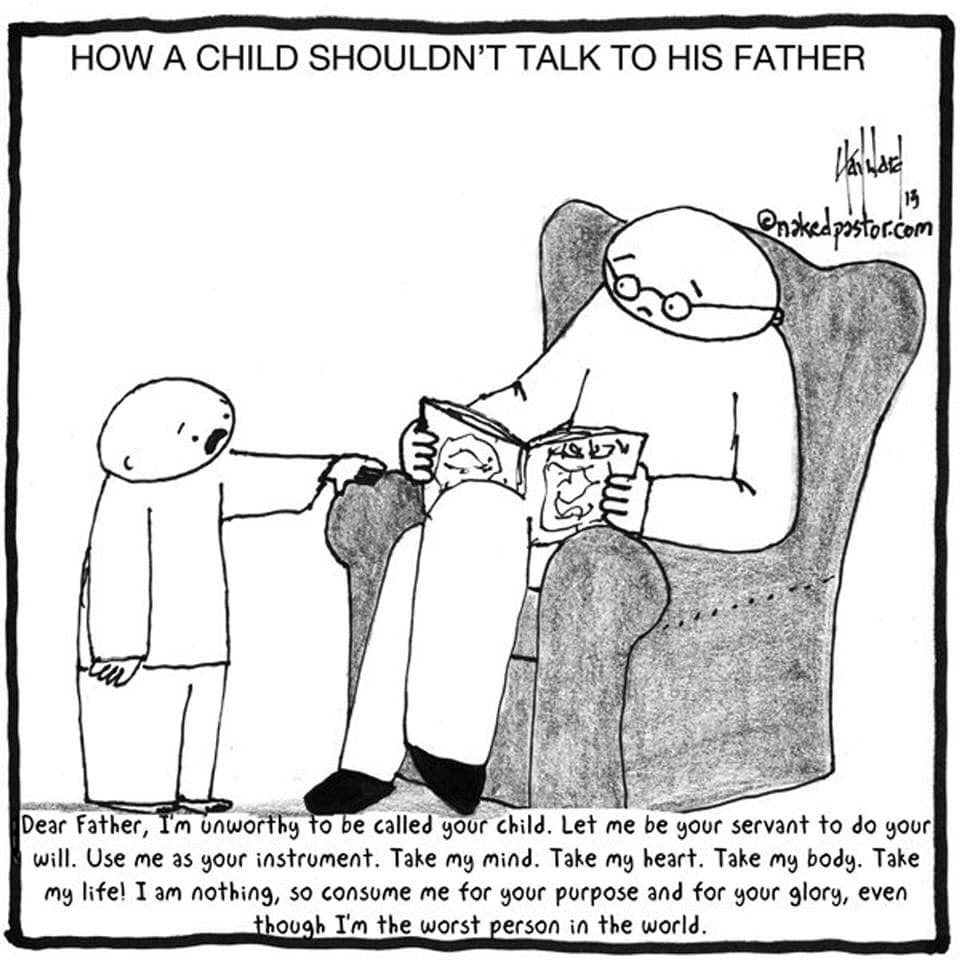
Here is the comic from Naked Pastor
This 5 minute video presents 3 ideas that come together in a powerful way.
Here is my most adventurous and experimental theology.
Please let me know what you think and how I can tighten up the concepts (as I will be presenting this to a live audience soon)

This is my 3rd and final semester in my year of being a seminary professor. I have loved it and have learned so much about faith formation and the local church (more on that this fall).
It is rewarding to introduce students to concepts such as the Surplus of Meaning and the god revealed in Christ (GRIC). I get lots of feedback on my 5 min. video about the 5 Gods That People Believe In as I rank them from highest to lowest in ‘level of commitment’.
The schema goes from ‘highest’ to ‘lowest’:
5 – SuperNatural Agent
4 – Divine Being
3 – Ground of Being (GoB)
2 – the Go(o)d
1 – Event
A student reached out to me for clarification on the ‘level of commitment’ schema. Here is part of my response:
Who said anything about omni-potent?
One of the difficulties of being both a believer, and for me, a pastor is how much time and energy gets taken up by the god that you don’t believe in. I believe in god very deeply and have given much of my life to teaching and leading people into a fuller understanding of faith in and participation with the divine-eternal-transcendent.
I love and try to imitate Jesus. I guess that makes me a Christian. Which is fine because even if there was no such category as ‘christian’, I would still be fascinated with the phenomenon that gets labeled the spirit of Christ/the spirit of God/Holy Spirit. My attraction to the field of practical theology is to examine the ways that religious communities and people of faith live out their beliefs in embodied practices.
I am really committed to this thing that gets called belief-faith-religion. It plays an important role in my life, in my family, in my networks, in our society, and in our world. I feel the need to say this because I get frustrated at the increasing amount of time and energy that gets taken up explaining what I don’t believe.
God has really gotten out of control in our culture. You say that you believe in God or that you have had a religious experience and suddenly you find yourself defending lofty and foreign concepts like omnipotence, omniscience, omnipresence, immutability, and impassibility. You get overwhelmed by an avalanche of historical atrocities and are asked to defend classic conceptions of an all-mighty or sovereign god in the face of human evil and suffering. Now there are accusations of hypocrisy, genocide, crusades, sexual abuse, and every manner of discrimination and hate.
All I said is that I like Jesus and the one that he called Abba. What have I been pulled into and am I obligated to adopt/defend all of these other things? Is it possible that the concept of God has gotten out of hand and grown over the centuries into the bloated and oversized thing that is unsustainable and indefensible?
Are we allowed to downsize this whole thing to a more understated and humble version? Someone might ask “you want a more manageable god?”
It’s not that I want to manage god or be in control of god … I just want a conception of god that isn’t so amped up, highly-caffeinated, or on steroids. I was looking at a model in the range of ‘the god revealed in christ’. I find that a compelling vision of god – more servant than Caesar, more nurturing parent than distant monarch.
I feel at times like the person looking for a reliable car but getting stuck with a pushy salesman who is bent on getting me into something bigger, faster, more powerful, and fancier. I just want something that gets there, I’m not sure about all the bells and whistles – nor can I afford the payments on the luxury model.
I’m looking for a place to rest but all the mattresses are king-sized, pillow top, space-age foam, with dual temperature control and animated bi-level posture support. I was hoping to watch the evening news and maybe enjoy a game on the weekend but all the cable packages are premier bundles with 500 channels from 130 countries including an extreme sports package and a 100 gigabyte DVR included with your unlimited data upgrade.
A smaller and humbler vision of god seems like heresy to most folks for whom the whole point of there being a divine being is that it is the biggest and best of whatever it is that you would value. Anything less, it appears, is not even worthy of worship and so it becomes an all or nothing dichotomy where God had better be everything that has been promised or there is no point in believing in God at all.
Like so many other things in our culture right now, religion has been turned up to 11 and you had better like it OR YOU CAN GET THE HELL OUT!
Through the advent season and into the new year, my meditation has been on the incarnation and the amazing reality that the eternal word (logos) became flesh and dwelt among us – emmanuel means that god is with us. For good or bad, god is now eternally bound up in the creatures’ fate. God has not only identified with humanity but has become entwined with humanity.
Incarnation is why our bodies matter to god and why our embodied practices mean as much or more than our ideas and concepts about god. I’m looking for the God Reveled In Christ.*
Tomorrow I want to ask if the classic notion of the big-god was destroyed when we entered the nuclear age. I’m not sure that conception of god survived the explosions in Hiroshima and Nagasaki. Like the star over Bethlehem, the mushroom clouds loom over us and divide history from its previous era.
_____________________
*I understand that G.R.I.C. may not be the biggest or best. I get that when we say ‘GOD’ we are saying more than ‘human’ loudly. I have no interest in projecting all of our hopes and dreams onto the screen of the heavens. I accept that those who hold to the inflated and super-sized Almighty King of the Universe are the gate-keepers and boundary guards of what they term orthodoxy. It has taken me 20 years to get comfortable letting go of their interpretation of the KINGdom but after surveying the theological landscape, I am sure that there is plenty of real estate that does not require certainty as an entrance fee.
The 3-letter word ‘god’ gets used to signify a number of different concepts. Here are 5 popular ideas that people are attempting to express when they talk about ‘god’.
I have ranked them from the highest level of commitment to the lowest for this 5 min video.
I would love your thoughts and feedback for an upcoming presentation/use of this model.

It is almost Easter – my most conflicted time of year as a pastor.
I am smitten with the empty grave. In fact, I am almost as excited about the Easter imagery as I am horrified by N. American Protestant’s fascination with the cross.
I have written and talked about this disturbing trend in the past so I won’t take the time to elaborate on it here.
This whole subject has been intensified for me this year. I have been leading a discussion at my church through Lent about historic atonement theories. The hope in doing so has been twofold.
We have been working through this in conversation with several resources: Saved From Sacrifice, The Non-Violent Atonement and the work of Michael Hardin.
It has been a powerful excersise and I have learned a great deal in the process. It is the week before Palm Sunday and I have two things in the back of my mind:
His famous jab at ‘liberal’ christianity:
“A God without wrath brought men without sin into a kingdom without judgment through the ministrations of a Christ without a cross.”
This quote gets under my skin so much. Here are 3 reasons why:
1) It is so true. I suspected it when I migrated out West and it is has only been confirmed as I have emerged from an charismatic/evangelical context to a more mainline one. I can not tell you how many people would be covered by Niehbuhr’s concern.
2) We live in a sanitized and sterilized culture (to paraphrase Cornell West) where most people have no connection to the meat on their table. They pick it up at the grocery store in plastic wrapped styrofoam containers. I say this as an avid hunter descended from farmers. We live in a horrifically violent culture (both domestic and military) but so few of us are familiar with blood. We outsource our violence.
This is why a penal substitutionary view of the cross is so attractive /acceptable for so many. The vicarious nature of god pouring out ‘his’ wrath on Jesus results in a pornographic delight that can be seen in depictions like that famous scene in The Passion and in many of our contemporary worship songs.
3) That Niehbuhr quote is thrown around too easily whenever someone wants to reexamine or revisit underlying assumptions about what happened (or how we understand) Easter.
Let me be clear about what I am saying and what I am not saying:
I am not saying that there was no cross and that there was no blood. I get both, I accept both and I proclaim both.
I am saying that something perverse has seeped into our understanding and our imagery.
My concern is that we have misunderstood both how it changed and why it changed.
Let me end the critique there and wrap up with a constructive proposal.
When Jesus takes the bread and cup and forever changes their meaning he is saying “what they will do to me – don’t you, as my followers, do to anyone else”.
When Jesus says “forgive them, they know not what they do”, he is saying that they think they know what (and why) they are doing, but they are wrong.
When Jesus says “it is finished”, he is proclaiming the end of this type of scapegoating and violence by those who think they are doing it on God’s behalf.
2 Corinthians 5:18 All this is from God, who reconciled us to himself through Christ and gave us the ministry of reconciliation: 19 that God was reconciling the world to himself in Christ, not counting people’s sins against them. And he has committed to us the message of reconciliation. 20 We are therefore Christ’s ambassadors, as though God were making his appeal through us. We implore you on Christ’s behalf: Be reconciled to God. 21 [The one] who had no sin [was made] to be sin, so that in him we might become the righteousness of God.*
We are to be about peace. We are to be a people of reconciliation. In Christ, God absorbed the hatred and violence of the world. The one who knew no sin – an innocent man – was proclaimed guilty and God responds by proclaiming that we who are guilty of doing that are now innocent and our sins are forgiven.
This is the good news of gospel! This is the hope for human-kind. No one needs to be sacrificed any more. No one needs to die because God is angry – Christ’s unjust death is to be the last. In the empty grave we see the vindication of the victim. God took humanity’s wrong judgement of Jesus and now judges us right with God. We who are guilty are proclaimed innocent because the innocent one was found guilty.
Easter is the great reversal and the vindication of the victimized. It is finished. We can’t afford to keep missing this and repeating the mistake. We who follow Jesus must be about peace and reconciliation. Too many have been scapegoated, placed on crosses and victimized by violence … in Jesus’ name.
God forgive us – we know not what we are doing.
Let it be finished.
In Jesus’ name.
* If that final verse reads a little different than you are used to hearing it, you should listen to the podcast with Michael Hardin.
 Bo Sanders: Public Theology