Search

Bo Sanders: Public Theology

updating & innovating for today

Category

God

the 99 and the Tebow: success, Billy Graham and Canada

I blog both here at at Homebrewed Christianity. Sometimes after a post rotates off the front page over then I re-post it here for ongoing conversation.

Several weeks ago I had fun looking at the difference between Tim Tebow’s* faith and what his zealous (mostly evangelical & charismatic) fans do with it. I took some flack from asserting that Jesus was not intervening to help him win close games.
Since then he has lost 3 games. The choir has gone shockingly quiet. It appears – and this may come as a surprise – that Americans worship success more than any ‘god’. In fact, one might wonder if success is America’s god.

It always piques my imagination when politicians say ‘May God bless America” at the end of their speeches … I try to pay attention to how they say it and what they might be expecting that blessing to look like.

 There are two elements to this that really attract my attention:

  • Part of the reason this sticks out to me so sharply is that I have dual-citizenship with Canada. I went to High school and started Bible College there. When I see Tebow bowed on the sideline praying in the 4th quarter, I smile as I think of the completely different religious and political atmosphere in Canada. Almost every Canadian I know – even the believers – I can hear saying “Easy big guy, don’t make too much of a display”.
American zeal is a phenomenon. I have a theory that it is actually embedded in the DNA of this country courtesy of those original Calvinists who brought with them the concept of “signs of divine benevolence”. This little mechanism says
‘while we can’t know who is elect unto salvation or damnation – certainly we say that a good tree will bear good fruit. So, while no can know for sure if they are “in” certainly God graces the chosen with “signs of divine benevolence”. Continue reading “the 99 and the Tebow: success, Billy Graham and Canada”
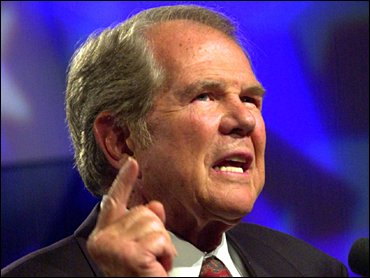
Pat Robertson makes me a better believer …

God told Pat Robertson who the next President of the United States will be.
You can watch it at Slate or read about in million other places.

Here is the thing: as much as people may want to make fun of the guy for being delusional I have to think that there may be something to be said for him.

If anyone follows my blogs either here or at Homebrewed Christianity then you know that I am a big proponent updating the faith. In fact, truth be told, I have written about it more than any other subject over the last 4 years.

I am especially interested in 3 updating things:

  • The way we read the Bible (hermeneutics)
  • The way we conceptualize the universe (cosmology)
  • The way we talk about miracles (metaphysics)

I have even gone so far lately as to publicly articulate why the miraculous is not super-natural and to research church history about eschatology (the end)… I have even shown concern about the evangelical icon Tebow [here].  All of that is to  say that I am not dabbling in this or being halfhearted… nor I am doing what so many that I know are and simply walking away from a faith that is not intellectually credible, scientifically accountable, or personally tenable. Continue reading “Pat Robertson makes me a better believer …”

Talking about Tebow’s God

This is a repost from Homebrewed Christianity. There was a wild discussion that ensued. I thought I would bring it over here as well – in case anyone wanted to have quieter conversation.

I have held off as long as I could but I think we better talk about this now before it goes any further.

Tim Tebow is a phenomenon is the media these days. His Denver Broncos football team is on a 6 game winning streak and he is 7-1 as their starting Quaterback. Despite his apparent limitations (skills) he has orchestrated a series of amazing comebacks during the winning streak.  That is a big deal! Any fan would love to have their team on this kind of a roller coaster – come from behind – frenzy.

That, however, is not what makes this news. Continue reading “Talking about Tebow’s God”

The Christmas message of the Angel

In Luke chapter 2 the Angel of the Lord says something really profound (v.14)

“Glory to God in the highest, and on earth peace among men with whom God is pleased”  (NAS)

It is beautiful in its simplicity.

I’m not trying to make this into a three point sermon, but it does seem to me that there are three interesting things said here:

God is pleased with us. That strikes me in a post ‘sinners in the hands of an angry god‘ era. Now, maybe someone wants to say that god was pleased with us before we killed his kid and rejected the gift… but that is not how I’m reading it here. Why is God pleased with us? Is it because god is gooder than we have been told? Probably. Is it because of something within God and maybe not within us? Possibly. But the bottom line is that God likes us and in Christ is well pleased with us! That is is a Christmas gift worth unwrapping.

Peace on Earth is God’s intention. God wants peace on earth. The angel said so. The sad part is that many Christians will argue with me about this. Fortunately, they probably disagree with part one (that God is pleased) as well … so you have take that as a whole package.

The Glory of God is peace on Earth. This is God’s house and we are God’s people. The state of your house and welfare of the people who live in it reflects something about you. The state of the earth and the welfare of the people who live in it reflects something about God. Now, people who emphasize the transcendence of God portray God as being so holy that God can have nothing to do with humanity’s sinfulness. The problem is that Luke 2 is about incarnation and God becoming one us. God is not just in the highest – as of Luke 2, God is also in the lowest.

So to you I say Merry Christmas! I join the Angel to say Peace on Earth! Goodwill to all mankind! For this is the Glory of God!

a BIG difference between Christianity and Islam

I continue to be very excited about the Claremont Lincoln University Project to bring together Jewish, Muslim and Christian scholars and practitioners. It is essential for the future that each tradition initiate its young leaders and thinkers in at atmosphere of mutual exchange and understanding.

The reason this is so important is that these three religions are not the same. They are not simply three expressions of a common understanding. They are vastly and distinctly different from each other. Of course there is commonality and overlap – for instance all three are a covenantal people and point to a covenant they have with God. I am interested to hear how each of the three groups reflects on and lives into their particular understanding.

Many Christians seem to think that the big difference between Christianity and both Islam and Judaism is what they believe about Christ. I do not think that views on Jesus is the biggest difference between the three. In fact, I am suspicious that any Christian willingness to revisit a wooden-literal reading of passages like John 14:6 or reexamine the language and meta-physics of the creedal formulations would easily result in an understanding that did not violate the Quranic understanding that God has no children. Vocabularies of ‘how God was present in Christ’ are already being worked out by followers of the prophet Isa (Jesus) in Muslim countries. [Link: an article on c-6 contextualization]

In my mind, there is a much bigger difference between the three religions than an understanding of Jesus’ identity. It has to do with the earth.

Christianity is primarily time based. While the Christian gospel is one of incarnation, ironically, Christianity has become something that is not place-based and especially not land-based. This is easily illustrated by looking at some Muslim practices and noticing their absence or contrast in Christianity.

  • Prayer Direction: When Muslim pray, they face Mecca. This is a directional earth-relative orientation. Christianity lacks this orientation.
  • Pilgrimage: Once in their lives Muslims are expected to make a pilgrimage to Mecca. This is an intentional journey to a specific location on the surface of the earth that holds special meaning. Christianity has no such thing.
  • Sunset: Certain holy days are marked as beginning at “sundown” or when a specific phase of the moon first appears as observed in a set location. This shows an awareness of the seasons, the sun, and the moon. Christian holy days and holidays are based on a calendar and clock.
  • Language: If you want to read the Quran you need to learn Arabic. The Christian gospel is not only translatable into any language – Christians believe that it should be translated into every language. The Gospel is equally valid in any and every language.

In his book Whose Religion is Christianity?: the Gospel beyond the West, Lamin Sanneh puts it this way:

Being that the original scripture of the Christian movement, the New Testament Gospels are translated versions of the message of Jesus, and that means Christianity is a translated religion without a revealed language. The issue is not whether Christians translated their scriptures well or willingly, but that without translation there would be no Christianity or Christians. Translation is the church’s birthmark … Christianity  seems unique in being the only world religion that is transmitted without the language or originating culture of its founder (p. 97-98) Continue reading “a BIG difference between Christianity and Islam”

Healing, Nature, Miracles, Prayer and Medicine

> I am at the end of my school year and, thus, writing papers. Here is an email conversation from a couple of weeks ago I had with a fellow minister. I wanted to post it and see if anyone had any reflections, objections, questions or comments.

If you already know the basics or have A.D.D. – just jump down to the sentence in orange and start there.

I will put JD’s thoughts in bold green and my responses will follow.

JD: Two thoughts on healing, medicine, and health care:

  • Our lack of theology of creation results in average people pushing against both modern medicine and many forms of holistic/folk medicine.
  • Many people are fearful of holistic medicines because of non-Christian spiritual components.

Me: I’m just going to throw out some ideas:
1) Creation was not ONE week a long long time ago. Creation is still happening. Look at the Hawaiian islands. Look at the tectonic plates that cause tsunamis.
This is ongoing creation.

2) In scripture God works through nature almost all the time. Burning bushes , winds on the sea of Reeds (Red Sea), clouds by day – fire by night… walking on water (the sea was Chaos in the 1st century) calming the storm, Sky turns dark, etc. This is Biblical.

3) The old saying is that there is no use praying for the cool of Spring in the heat of Summer. The seasons will be.
Continue reading “Healing, Nature, Miracles, Prayer and Medicine”

>Resurrecting space for belief

It goes without saying, Easter is a big deal. I only have to mention the significance of passages like Paul’s claim in 1 Corinthians 15:13-15 (NIV) 

13 If there is no resurrection of the dead, then not even Christ has been raised. 14 And if Christ has not been raised, our preaching is useless and so is your faith. 15 More than that, we are then found to be false witnesses about God, for we have testified about God that he raised Christ from the dead. But he did not raise him if in fact the dead are not raised.


As I a pastor I looked forward to Easter so much, but I knew that we would have  visitors, family members, and friends who would come to our services out of relational obligation or for social interest in the event. I knew that some of these would not believe in the literalness of the resurrection of Jesus’ body. 


I always had to think through how I was going to talk about this as a way that was both faithful in proclamation for us as a community of faith, while also attempting to be invitational and sensitive to potential objections or barriers from our guests. 


I have no interest in apologizing for what we believe as a faith community. But neither do I want to dogmatically push an ancient worldview that may, to the listener, be suspicious at best and incompatible at worst.  Continue reading “>Resurrecting space for belief”

>The springs of Saratoga – a story (part 1 of 2)

I have been talking about water the past two weeks: first Jesus walking on the water and then the healing pool in John 5.  I think a lot about mineral / hot springs and how they are a grace (gift) of God. I thought I might be good to pull back the curtain and share part of why they mean so much to me. 


Saratoga Springs, New York, is a unique little city that has grown up around a set of natural springs in the area. There are almost a dozen springs that are still in use. People come, sometimes from great distances, to drink, soak, and enjoy them.  Continue reading “>The springs of Saratoga – a story (part 1 of 2)”

>Stirring the Water

I love reading the Bible. I am especially fond of the Gospels. One thing that I am increasingly aware of is the need for translation to the modern world. Yes, we need it to be translated from Greek to English well but we also need to translate it culturally. There is a significant gap between the world that the text was written in and the one that we live in. 

I get lots of feedback from people who think that world is exactly the same as it was 2,000 years ago (angels, demons, prophecy, etc.) and that the only difference is we that have cars and computers and alarm clocks.  But they think that gender roles and scientific assumptions are not really that different. 


I think that everything from physics to language to cosmology, gender, empire and culture has been effected in major and minor ways. I think that the text needs to be both translated and  interpreted. It is not a 1:1 equivalent with our contemporary understanding. 


I want to look at a story from the Bible to illustrate how I think we can navigate the gap, translate for our age and time, and interpret in ways that are authentic for our present reality. 


My goal is to be faithful to the text while being accountable to our contemporary world. I want to find continuity with the tradition while being credible to the modern understanding. 
Continue reading “>Stirring the Water”

Create a free website or blog at WordPress.com.

Up ↑