Search

Bo Sanders: Public Theology

updating & innovating for today

Category

Uncategorized

Everything Just Changed

Join the Summer Reading Group for “Everything Must Change” by Brian McLaren 51YQr4ADE4L._SX321_BO1,204,203,200_

Every Thursday in June and July at 3 Pacific (6pm EST). You can get the book on Kindle or Audible if you don’t already have it.

Email anEverydayTheology@gmail.com to join

Everything Just Changed Reading Schedule

June 4              (dis)Orientation

June 11            Part 1: Two Preoccupying Questions

June 18            Part 2: Suicidal System

June 25            Part 3: Reframing Jesus

July 2               Part 4: Reintroducing Jesus

July 9               Part 5: The Security System

July 16             Part 6: The Prosperity System

July 23             Part 7: The Equity System

July 30             Part 8: A Revolution of Hope

Shalom Reading Group

Starting this evening at 5:30 PM PST on both Facebook and zoom chat we will be discussing the first three chapters of Randy Woodley’s book “Shalom and the Community of Creation”.

If you would like the Zoom meeting number just email anEverydayTheology@gmail.com

Or you can watch on FB live

Come and join the conversation!

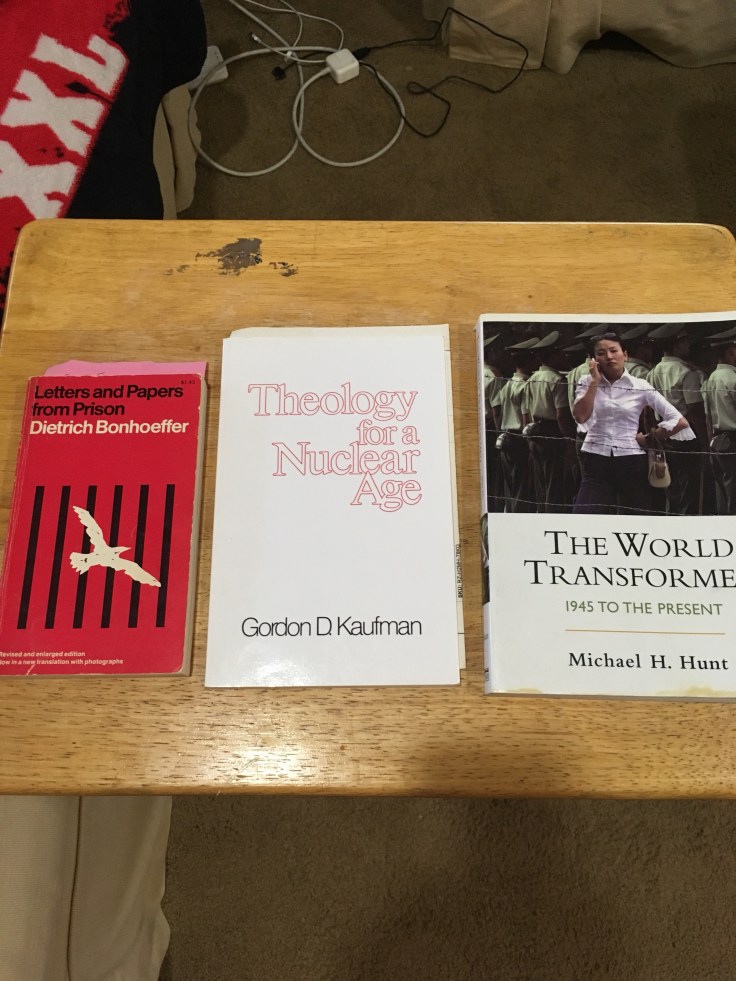
Guess What I’m Teaching On?

These are the prep books for tomorrow- guess what the topic is

Follow Up to Church 2.0

Yesterday’s visit by seminary students was so encouraging.


It did however bring up some issues that I did not cover in yesterday’s video.

5 issues from yesterday’s seminary visit:
– experience of absence
– small and big church
– rural, urban, and suburban
– diversity
– love the questions
-cynic and fool  [link to the book]

Here then is a followup video to cover those issues:

Let me know if you have any other topics to address.

Help Progressive Bible Study

I have read and learned a lot about the Bible.
Now I want to read the Bible again.

This has been a long time coming.

For the past 10-15 years I have been growing increasingly unsatisfied with the either/or options that were being presented.

  • Creation or Evolution
  • Catholic or Protestant
  • Democrat or Republican
  • Gay or Straight
  • Married or Single
  • Conservative or Liberal
  • Public or Private
  • Think or Do
  • Talk or Act
  • Faith or Reason

I have come to see that these binaries are not only unsatisfying and impotent but are in reality inaccurate and often deceptive.  If nothing else, they result in a round-and-round series of dead-end debates that lead nowhere and only serve to produce cul-de-sac brands of christianity that where folks in one camp don’t trust and don’t even know how to talk to folks from the ‘other’ camp.

When it comes to reading the Bible, the either/or options seemed to be:

  • one-dimensional black & white literalism
  • reductive dismissal and criticism

Both of those are unsatisfying and impotent.

So over the past 4 years I have been comparing notes with trusted friends and trading ideas with respected thinkers and practitioners. I have tried some new stuff out on Sundays in the pulpit and I have read lots of books about the Bible.

About a year and a half ago I have got to the point where I was tired of reading and talking about the Bible … and I want to actually read the Bible.

I know better than to do that alone … so I went on a journey and I found some fellow travelers. We come from all over the country but we have crossed paths in Portland.

We want to take a classic and give it a twist:

Starting Wednesday September 6th at 7pm we are going to meet in a church basement with Bibles open and read the scriptures together through a progressive lens.

So it begins …

____________

This is one of the blogs & articles that we have been preparing over at ProgressiveBibleStudy.com

I have asked a few close friends to take a look at it and now I am wondering if you will take a minute to help me out before we go public with this thing!

If you get a chance to look at it or to share it with someone who might be interested in the topic, that would mean a lot to us. You can post comments here, on that site, or email us at ProgressiveBible@gmail.com

Thank you ahead of time!


Excess Isn’t The Problem

Working on two different presentations this weekend, I ran into a familiar theme: the ‘problem’ of excess.

This afternoon I am teaching a class on ‘Theology in the Wesleyan Tradition’. The students are at the end of their semester and so I wanted to present something to them that will give them a chance to apply what they have learned this semester to a contemporary situation.

I was also working on a church service for two weeks from now where I will be filling in for the pastor who will be at regional gathering with most of the worship team. I am planning a creative Christmas interactive sort of experience.

In both of these projects I kept running up against the theme of excess. What would someone like John Wesley think of the world if we could reach back three centuries and bring him to today?  The Methodist (who he helped to found) were a people of moderation and temperance. They prioritized simplicity and focus. Many times this semester I have tried to imagine what they would think of the world and the Methodist churches that I have been visiting.

I imagine them being a little overwhelmed by the sheer amount of things and options. We live in an age consumption in which manufactures compete to get consumers the variety and amount of whatever they desire.

At the same time, I am preparing for Christmas and trying to address the pervasive chorus I hear about the extravagance of what Christmas has become. This weekend I watched some football on TV, I had to go the mall to get a package, and I went to church to observe the second week of Advent. I get it … the season is a lot. I hear what people are complaining about and I 100% acknowledge that it can frazzle the nerves and trigger some soul-searching about the modern world.

I am haunted by a lingering suspicion and I want to put it out there for your consideration:

What if excess isn’t the problem? What it excess is the venue and virtue is the issue?

I think about trying to watch football on TV with John Wesley and how I would explain the commercial for 800 channels of cable to him. Why do we need 800 channels? We don’t. So what is the problem? I get why people complain about excess. I do.

I am just wondering: what if excess is the given and that how we handle it is the variable.

So I went to the store for cheese and there are literally 200 varieties. I don’t have to eat them all. In the same way,  I don’t have to watch every show on every channel of TV, flirt with every attractive person in a restaurant, or desire every item that is advertised to me.

We make choices. Those choices are born out of a character. That character is formed and informed by a virtue that I embody and which is enacted by the choices I make and how I behave.

I just wonder if we wouldn’t be better off to spend our energy talking about character-in-community instead of complaining about the ridiculous and excessive manifestation of modern consumer society. It feels like a golfer complaining about the presence of grass or a fish complaining about the presence of water. Excess is the venue of western society. We are not going to go back to the 4 kinds of cheese (Swiss, American, Cheddar and Velveeta) or the 3 network channels of my childhood (ABC, NBC, CBS). Costco isn’t the problem (per se).

Excess isn’t good – but neither is it the problem. Complaining about it, while legitimate and justified, may be an exercise in futility. We are not going back to a simpler time anytime soon.  In fact, pointing out the problems of excess may be a good diagnosis but still leave us with the lack of a cure. Even if excess is a problem, the lack of it is not a solution. We are still left with the absence of something deeper.

Spending this past semester studying Methodism has been good for me to think through this stuff. Going back to a simpler time isn’t the solution … and I’m arguing that living in an age of excess isn’t the problem. The absence of excess doesn’t result in the presence of character.

My growing conviction is that excess isn’t the problem, it is merely the venue and virtue is the issue.


Encouraged Ecclesiology

One of the courses that I have been teaching this fall is on ecclesiology (the church). It has been wonderful to interact with students from a diverse array of backgrounds and denominations. I have loved facilitating the conversation and orchestrating their interactions over the readings.

It has also been interesting for me to do this during a period when I am not in pastoral ministry for the first time in 18 years! I have been visiting different churches as I am teaching this class and that has been an eye opening experience in some ways.

I was researching something else and I stumbled on an author, Len Sweet, who played an important part in getting me to Portland the first time. I had lost track of his work since I was focused on more academic stuff the past 7 years. It turns out that he is even more into Jesus than he used to be! He is really Jesus-centric.

If you want to read an interesting interview with him, check this out [link].

Anyway, I want to share one quick idea with you:

Sweet has this idea called ‘Theography’ – like Jesus is a story (biography) of God. This idea is interesting on its own. Jesus as theography is an intriguing concept.

What I am more interested in, however, is taking this concept and expanding it for the purpose of ecclesiology.

If Jesus is a theography – does that make the church a Christography?  

Are we telling the story of Christ by how we are in the world?

Church as Christography is a concept that I want to explore in the new year. What does it mean to participate in the narrative of God? How do our communities continue the unfolding story of God’s love in Christ? Is the Spirit of Christ the animating presence in our churches? Is the life of the Spirit how God is telling a story with us?

This concept just holds so much possibility. What are the implications for our framing metaphors of ‘the body of Christ’, the bride, the temple of the Holy Spirit, the people of God, etc. ? Does it help us get away from a substance-essence debate? Does it undo the limitations of foundational understandings in a fluid culture?

Let me know if you have any thoughts. Do you like the idea of the church are the ongoing story of Christ? 

Morphing Nature of Race and Gender

Understanding both race and gender can seem difficult at times. Concepts can be illusive and definitions can feel like they change mid-course.

What if it turns out that it doesn’t just seem that way – it actually is that way?

An article that has been very helpful to me is by Troy Duster called “The Morphing Properties of Whiteness” in the book The Making and Unmaking of Whiteness.

His approach moves us from an ‘essentialist’ understanding of race to an elemental one. That is my phrasing, not his – but it holds great possibility for discussions around race and, I would add, gender.

It is in vogue today to say that is race is not a biological reality (DNA, science, etc) but is instead a socially constructed category. That is fine and true BUT that does not help us deal with historical and ongoing effects of race and our previous racial understandings.

In adopting a “Morphing Properties” approach, it gives us a framing metaphor of steam/water/ice to help distinguish between abstract concepts (gas), fluid definitions (liquid) and concrete consequences (solid). It also acknowledges that things can change very quickly. His personal story on p. 123 is telling.

I have been using this article for over a year in whiteness workshops, church settings, and in the classroom. It seems to help people make sense of an overwhelming, complicated, and elusive topic. This gives them an entry point without their white fragility causing them to get their hackles up right away.

I have also started utilizing the elemental approach to gender with those who have inherited an essentialist binary of male/female. I am working here off of Elaine Graham’s Transforming Practice where she engages Judith Butler’s notion of perfomativity. (see below)

I’m arguing that masculinity is performed and that whiteness operates on a performative register.

My thesis: We enact and embody (concrete) our understandings and ideas (abstract) in a fluid environment of social relationships (liquid).

This is a conversation that I would very much like to have in 2017 so I wanted to recommend this article.

If you are looking for a good paperback, I would suggest How The Irish Became White.
If you want a good (and inexpensive) Kindle book, The History of White People is a doozy.

Continue reading “Morphing Nature of Race and Gender”

Jesus 2.0

5 min on Christology using 4 splits that frame the debate.

  • Divine/Human
  • Jesus/Christ
  • Unique/Particular
  • Type/Degree

This approach recognizes that Jesus was unique in human history in that:

  1. Jesus shows us something unique about God
  2. God was present with Jesus in a unique way that comprised Jesus’ identity and character.

It avoids the dangerous temptation to say that Jesus was not fully human, only appeared human, or was a different kind of human. It also allows us to embrace Jesus as a model for full-humanity (to the Nth degree) and openness to God’s calling in our own lives.

I would love to hear your questions, comments, and concerns.

Create a free website or blog at WordPress.com.

Up ↑