Search

Bo Sanders: Public Theology

updating & innovating for today

Tag

Religion

Kneeling Honors The Founders

You are free to disagree with me.

And that is the beauty of this issue.

You are free and you disagree.

Welcome to America.


Three things I would like you to consider:

  1. America is founded on protest
  2. Protestants are the largest group in America
  3. The national anthem is too special to sing at every game


America is founded on protest. The founding fathers were literally protesting things like ‘taxation without representation’ and the divine right of kings.

Protest is baked in the American bread – it is embedded in the DNA of our nation.

So kneeling during the national anthem is the perfect time to do so and it honors the ideals that this country is based on. The timing is part of what makes the protest so poignant. It would be so much less powerful if players knelt during the first commercial time-out.

In fact, seen in a certain light, kneeling is probably the perfect way to honor this aspect of our rights as Americans. By one definition, Kneeling is a basic human position where one or both knees touch the ground. It can be used:

  • as a resting position
  • as an expression of reverence and submission
  • as a mark of respect
  • during childbirth


Protestants are the largest group in America. It always shocks me when protestants demand conformity and control. Look no further than our name to see that we are born in protest. The entire enterprise is based on the individual’s conscience. [1]

Martin Luther famously said, “here I stand and I can do no other”. An NFL player might say, “here I kneel and I can do no other”.

If you are a white person in America, you should defend player’s rights to kneel no matter how much you disagree with the timing or the message they are trying to convey about policing practices in minority communities. That is what freedom is all about.


The national anthem is too special to sing at every game. I love the singing of the national anthem at big events like the Olympics. That makes sense because the athletes are representing their country. I have never understood why we need to sing a worship song to America before we play baseball or football.

I stopped singing the national anthem before non-national games when I was an athlete living in Canada. At first, it was because I was not Canadian. Then I became a dual-citizen but it had stopped making sense to me.

I do honor the singing of the national anthem before USA Soccer matches – that makes sense because the players are in the red-white-and-blue. I swell with pride when the anthem is played after an athlete wins a medal at the Olympics.

Singing it before every single sporting event seems inappropriate. Let’s save it for international games and make it truly special.

Of course, you are free to disagree.


[1] Nerdy sidenote: the same can be said for evangelicals, fundamentalists, charismatics, and pentecostals, who call someone ‘heretical’ or claim ‘orthodoxy’. You might want to go to your nearest Orthodox church (they are very welcoming actually) and ask the man in charge what he thinks of your modern take on Christianity. Spoiler alert – you are not orthodox.
Bound In Conflict & UnBound In Love

We live in a time of division and conflict.

It is perfect timing then, that our topic this week comes from Galatians 3 and says, “In Christ, there is neither male nor female, slave nor free, Jew nor Gentile … all are one.”

Usually when this topic comes up people want to focus on how Christ’s love “bridges” the divides between us.

I want to take it a step further! I want to look at how:

A) we are bound up in those categories of sex, religion, and politics

B) Christ’s love ruptures those categories and un-binds us from them

The love of God doesn’t just bridge the divisions among us – it binds us together in love and undermines the very categories themselves.

God’s love calls into question the human categories of:

  • Gender
  • Sexual Orientation
  • Religion
  • Politics

Love UnBound doesn’t just help us bridge the difference between us – it unbinds us to see the other in such a different way that our categories themselves are called into question.

Here is a short video – let me know what you think …

Video: No Neutral Anymore

We live in changing times. This is part 3 of ‘Why things seem so bad right now’.

You can read the full post here [link]

Human knowledge and meaning making are culturally conditioned and socially constructed. This leads to a contested atmosphere.

Video for part 2 is here: Fragmented and Fractured

Why Things Seem So Bad (part 1)

This week I want to offer a 4-part series that addresses some issues behind the current state of affairs.

People are concerned about what they see happening right now. There are geographic divisions that seem increasingly pronounced. There are generational, political, and racial division that are inflamed at troubling levels. The news cycle, social media, and institutional corruption (banks, schools, churches, government, hospitals, Hollywood, Washington, etc.) provide a constant string of crisis and controversy.

Things seem to have escalated quite a bit in the past couple of years. Some people will say ‘every generation thinks things are chaotic and out of control’ and there is some evidence of that. However, we live in a unique era when there are the some distinct factors causing an intensification that is notable.

Change is a constant, we know that. Change at this rate, is not. We live in a time of exponential (not just incremental) change. It is no wonder that this environment breeds so much conflict and chaos.

One of the things that I would like to explore is the way that following 3 factors come together in a troubling way:

  • Consumerism
  • Globalization
  • Pluralism

The connection between those three might not seem clear initially, but it is the way that they come together in the 21st century that is relevant for our conversation.

Consumerism is so assumed that it often goes unnamed. It is as if we are on automatic pilot. Buying things has become second nature. I know people who claim to be Christians who can go a whole day (or days) without praying but can’t go a day without making a purchase. Capitalism is the real religion of the West. [1]

Consumerism makes us individuals – or is it that individualism makes us consumers? … either way, we have exposed the root of the problem. Speaking a language, participating in an economy, procreating and raising the next generation, and nearly every other human activity is a communal enterprise that requires cooperation and mutuality. Individualism is a mental fiction we have been sold that fails us at nearly every turn.

Globalization has brought our communities into closer proximity than ever before. We have never had this much access to or contact with one-an-other. It almost doesn’t matter where you live anymore, you have access to goods from all over the world. In fact, you do business with, go to school with, and stand in line with people from all over the world. You may all have different religions, worldviews, or notions of community and belonging. We live in age of radical connection and proximity …. but maybe not overlap. And therein lies the problem for our concern this week.

Pluralism is then a relevant factor that completes our trio. As individuals whose communities are in great proximity to each other, we have to develop an approach to one-an-other.[2] Some of us feel like we have does this well. Which is why it is so baffling why it cause some of our fellow citizens so much agitation and even anger. ‘Difference doesn’t need to lead to division’ we say, and if attitude or acceptance was the only issue we might be right. The problem is that the first two ingredients to trio are the wood and gasoline that make our current environment so flammable. Attitude (or our approach) is just the spark that makes that situation combustible.

Here is the most important thing to understanding our current culture:

Our society is a set of fragments – leftover remainders – of previous expression that may not be compatible with other or newer expressions.

Again – our society is a set of fragments, leftover remainders, of previous expressions that may not be compatible with other or newer expressions. More on this tomorrow. The examples of this phenomenon are endless once you know what you are looking at. Think about religion, Christian denominations, theories of educations, economics, politics, nationality and race, pre-1975 military, for-profit prisons, policing strategies, parenting styles, marriage equality, even grammar and texting language.

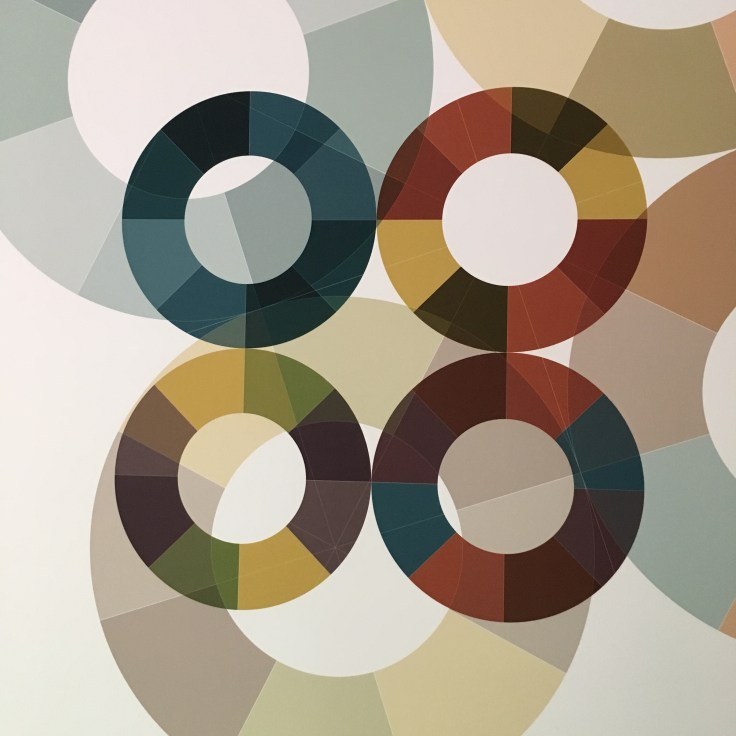
Here is a picture that I want to utilize for this 4-part series. It is a piece by my neighbor Jeff and it really speaks to me.

IMG_7259

Our circles (communities) have diversity and differentiation within them. Those circles are in close proximity to each other and are even connected … but without overlapping. They are not integrated. They do not bleed into each other. They are distinct from one-an-other.

What makes this proximity profound is that the newer circles are smaller and bolder but are foregrounded on other circles that are faded but still present. Those larger circles are older and not as pronounced but influential. They haunt the work. They are ghosts and shadows to the primary feature. They are echoes of the past who still exert their voice. Their influence has faded but their effect still remains. The current configuration and focus wouldn’t make sense without them.

Tomorrow we talk about the nature of these remaining fragments and how people who think about such things differ on the subject.

_____________________________

[1] There are so many great  books on this, including For The Common Good by Daly and Cobb and What Money Can’t Buy by Sandel. I would also recommend the non-academic book The Suburban Christian by Hsu.

[2] I find this way of writing it helpful. It may seem clumsy at first but it will bear fruit later in the series.

Y is for Y2K

Is the way that the world runs today the way that is has to be?
What would it take for the world to work a different way?
Can you imagine something better than democracy or an economic system after capitalism?
Is society in its final form?

[We are nearing the end of the ABCs of Faith in Sunday School . Listen to previous discussions here]  Expanded PDF : Y is for Y2K (preview)


From 1991-2003, I was taught to read the Bible in one hand and the newspaper in the other – I no longer believe that.

In my short lifetime I have seen so many predictions come and go. I have seen layers and layers of moving onto the next thing a passage means without even acknowledging that 6 months ago we were told it was something different.

I just had a talk this weekend with a denomination leader about how end-times expectations have changed in their lifetime. We talked about young leaders and how different their eschatology is from 50 years ago.

My hope for the next 3 decades is that sincere people of faith get fatigued on this unfulfillingway to read the Bible and this next generation is released and empowered with an understanding of genre that does not leave them susceptible and vulnerable to panic over sensations like y2k and franchises like Left Behind.

The world is in too great a need for really great people to be distracted by thinking that apocalyptic is A) predictive and B) about the 21st century.

Here we have 2 crippling problems to confront – and the problem is that they compound the effect of each other intensely.

The more minor problem is the one that we have touched on above: a loss of the prophetic or our Christian imagination.

The major, and more hideous problem, is something called “final forms”. We live in an era where systems have become so solidified, concrete, and assumed that are assumed to be ends in themselves.

  • Capitalism is the pinnacle economic system.
  • Democracy, while flawed, is superior to all others.
  • Nationalism will never be topped or undone.

They are final forms that, once invented or introduced, are here to stay.

And there is an ominous implication:

  • Christianity is purported to be in its final form.

The faith we have today cannot be reexamined, tinkered with, or questioned. It is written in stone and unchanging.

In fact, it gets worse – true Christianity was found in the early church and the answer to our current problems is to get ‘back’ to that kind of a faith – sort of a ‘make religion great again’ mentality.


Come this Sunday at 9 to hear the rest …   Art for the series by Jesse Turri


The God Revealed In Christ

Who said anything about omni-potent?

One of the difficulties of being both a believer, and for me, a pastor is how much time and energy gets taken up by the god that you don’t believe in. I believe in god very deeply and have given much of my life to teaching and leading people into a fuller understanding of faith in and participation with the divine-eternal-transcendent.

I love and try to imitate Jesus. I guess that makes me a Christian. Which is fine because even if there was no such category as ‘christian’, I would still be fascinated with the phenomenon that gets labeled the spirit of Christ/the spirit of God/Holy Spirit. My attraction to the field of practical theology is to examine the ways that religious communities and people of faith live out their beliefs in embodied practices.

I am really committed to this thing that gets called belief-faith-religion. It plays an important role in my life, in my family, in my networks, in our society, and in our world. I feel the need to say this because I get frustrated at the increasing amount of time and energy that gets taken up explaining what I don’t believe.

God has really gotten out of control in our culture. You say that you believe in God or that you have had a religious experience and suddenly you find yourself defending lofty and foreign concepts like omnipotence, omniscience, omnipresence, immutability, and impassibility. You get overwhelmed by an avalanche of historical atrocities and are asked to defend classic conceptions of an all-mighty or sovereign god in the face of human evil and suffering. Now there are accusations of hypocrisy, genocide, crusades, sexual abuse, and every manner of discrimination and hate.

All I said is that I like Jesus and the one that he called Abba. What have I been pulled into and am I obligated to adopt/defend all of these other things? Is it possible that the concept of God has gotten out of hand and grown over the centuries into the bloated and oversized thing that is unsustainable and indefensible?

Are we allowed to downsize this whole thing to a more understated and humble version? Someone might ask “you want a more manageable god?”

It’s not that I want to manage god or be in control of god … I just want a conception of god that isn’t so amped up, highly-caffeinated, or on steroids. I was looking at a model in the range of ‘the god revealed in christ’. I find that a compelling vision of god – more servant than Caesar, more nurturing parent than distant monarch.

I feel at times like the person looking for a reliable car but getting stuck with a pushy salesman who is bent on getting me into something bigger, faster, more powerful, and fancier. I just want something that gets there, I’m not sure about all the bells and whistles – nor can I afford the payments on the luxury model.

I’m looking for a place to rest but all the mattresses are king-sized, pillow top, space-age foam, with dual temperature control and animated bi-level posture support. I was hoping to watch the evening news and maybe enjoy a game on the weekend but all the cable packages are premier bundles with 500 channels from 130 countries including an extreme sports package and a 100 gigabyte DVR included with your unlimited data upgrade.

A smaller and humbler vision of god seems like heresy to most folks for whom the whole point of there being a divine being is that it is the biggest and best of whatever it is that you would value. Anything less, it appears, is not even worthy of worship and so it becomes an all or nothing dichotomy where God had better be everything that has been promised or there is no point in believing in God at all.

Like so many other things in our culture right now, religion has been turned up to 11 and you had better like it OR YOU CAN GET THE HELL OUT!

Through the advent season and into the new year, my meditation has been on the incarnation and the amazing reality that the eternal word (logos) became flesh and dwelt among us – emmanuel means that god is with us. For good or bad, god is now eternally bound up in the creatures’ fate. God has not only identified with humanity but has become entwined with humanity.

Incarnation is why our bodies matter to god and why our embodied practices mean as much or more than our ideas and concepts about god. I’m looking for the God Reveled In Christ.*

Tomorrow I want to ask if the classic notion of the big-god was destroyed when we entered the nuclear age. I’m not sure that conception of god survived the explosions in Hiroshima and Nagasaki. Like the star over Bethlehem, the mushroom clouds loom over us and divide history from its previous era.

_____________________

*I understand that G.R.I.C. may not be the biggest or best. I get that when we say ‘GOD’ we are saying more than ‘human’ loudly. I have no interest in projecting all of our hopes and dreams onto the screen of the heavens. I accept that those who hold to the inflated and super-sized Almighty King of the Universe are the gate-keepers and boundary guards of what they term orthodoxy. It has taken me 20 years to get comfortable letting go of their interpretation of the KINGdom but after surveying the theological landscape, I am sure that there is plenty of real estate that does not require certainty as an entrance fee.

Wisdom of the Wesleyan Quad

The Wesleyan Quad is my 2nd favorite theological concept.

  • Scripture
  • Tradition
  • Experience
  • Reason

In this video we look at those 4 configured as a living web of interpretation. I hold that it is far better for community discernment than a foundationalist approach (the classic sequence).

Let me know if you have questions or concerns – especially about the little game of 3 minus 1.

10 minutes on Afterlife

Life after death, the afterlife or the hereafter provide a major focus for some people’ interest in religion.

Here are some of my thoughts about the historical development and ongoing progress on our the way imagine eternity and the poetics involved. Nov20sw1

At the end is a constructive, innovative proposal of how we can address this major topic.

10 Minutes on Religion

Religion is a tricky subject. Many assume that they know what it means while others have decided to reduce religion to fantasy in order to dismiss it.

The hope is to move from an either-or model of ‘true’ or ‘false’ to a “web of meaning”.

My theory is that at least 5 elements contribute the web of meaning. This moves us away from an either/or model of ‘antiquated myth’ or ‘divine revelation’.

5 elements are:

  • Experience
  • Formation
  • Event
  • Mystery
  • potentially something RealRoadPortraitSunsetD&B

This last one is always the most difficult. Those who are sure (fundamentalist, foundational) dislike the ‘potential’ qualifier. Those who dismiss religion are suspicious of the potential of something ‘real’.

Once we get rid of the false either/or choices we are free to think about what is going on in religion.

I look forward to your comments, questions and concerns.

Blog at WordPress.com.

Up ↑