Search

Bo Sanders: Public Theology

updating & innovating for today

Category

Uncategorized

Quick Bib on Theological Education

My friend Brekke was looking for a cross-cultural bibliography on religious education.  Here is my quick list.  I would love to hear your additions – since my most recent book is 2005!old-books-300x203

___________________

Breckenridge, James F., and Lillian Breckenridge. What Color Is Your God?: Multicultural Education in the Church. Victor Books, 1995.

Engen, John H. Van. Educating People of Faith: Exploring the History of Jewish and Christian Communities. Wm. B. Eerdmans Publishing, 2004.

Foster, Charles R., and Lisa Dahill. Educating Clergy: Teaching Practices and the Pastoral Imagination. Jossey-Bass, 2005.

Miller, Randolph Crump. Theologies of Religious Education. Monograph Collection (Matt – Pseudo), 1995.

Wheeler, Barbara G., and Edward Farley. Shifting Boundaries: Contextual Approaches to the Structure of Theological Education. Westminster John Knox Press, 1991.

10 Minutes on the Bible

I am deep in study these days as I prepare for my exams this September. I have also taken a break from blogging since I left HBC at the end of May.

I’m going to experiment in July with making some short videos for discussion. Below is a 10 min video I made for a class I am teaching at church. We are doing a 6 week study on ‘faith basics’ and some folks missed week 2 on the Bible but heard it was interesting and asked me for a recap.

My basic concept here is that a 4-fold approach to the Bible would be really helpful in the 21st century. The 4 elements are:

  1. The Event
  2. Background Material – cultural/textual
  3. (re) Prestentation
  4. Interpretation/Application

I’m talking quickly because I needed to erase the whiteboard in prep for week 3 (about God) that was about to start.

I would love to hear your thoughts, questions, and concerns.

Bible Stuff 10 Min from Bo Sanders on Vimeo.  Here is a link https://vimeo.com/133009864

On Earth Day

Today is Earth Day and I wanted to share 2 things: a quote and links to the HomeGrown series of podcasts. HomegrownLogo_green_rev1

Reading ‘Theology At The End Of Modernity’ – our text for the upcoming Summer School High Gravity class – chapter 1 Sallie McFague says:

We have the powers of destruction no other species has ever had, as our deteriorating ecosystem clearly illustrates. The ongoing history of our planet will necessarily involve our partnership and our participation for its well-being. This does not mean assuming an attitude of control toward the planet, hoping we come up with a quick technological fix. Responsible partnership means adjusting to the rules and rhythms of the earth, adapting to its reality …

Our loyalty must move beyond family, nation, and even our own species to identify, in the broadest possible horizon, with all life: we are citizens of planet Earth.

Last year we did a series called HomeGrown Christianity and got 4 parts into a planned 8. This Summer we will publish the next 4 in preparation for the Pando Pupulus conference ‘An Alternative Vision’.

Here are the 4 episodes for your listening pleasure:

1 – Leah Kostomo – on being planted

2- Matthew Sleeth – on the Gospel according to the Earth

3- Jen Butler – about On Earth As In Heaven

4 – Randy Woodley – on Shalom and the Community of Creation

April Update

My PhD Qualifying Exams have been postponed until September. I have siphoned off some time from studying to put out some stuff on HomeBrewed that I wanted to share with you:

An interview with Grace Ji-Sun Kim and Joseph Cheah on the cultural implications of a media sensation: Gangnam Style. This is theological look at the internet phenomenon and the Asian-American experience.

For The Bible Tells Me So with Peter Enns. This Biblical scholar addresses everything from genocide, to Paul’s view of his own Jewishness, to Biblical innerancy.

Today we are releasing an interview with Bonnie Miller-McLemore on Practical Theology.

I returned to the TNT show for a Call-In Special where Tripp and I respond to listener messages.

Freestyle Christianity had me on as a guest to chat about my passion for theology lived out in community.

I will also be leading a Summer School High Gravity class called ‘Living Options in Christian Theology’.
Here is a plug for the class: We are interested in a vibrant approach to a contemporary theological framework that doesn’t require a complete overhaul of your already existing faith.

  • Is Process too big of a leap?
  • Does Radical Theology provide too little substance?
  • Is Practical Theology just too darn practical?

Looking for a robust, thoroughly-Christian theological framework for the 21st century?

Then we have a conversation for you!

As I have taken some time off these past several months, I have noticed a couple of trends:

  1. Process is just too big of a conversion for some. They like the ideas and enjoy that Tripp is so jazzed about it … but it is a major commitment to learn that vocabulary and overhaul nearly every aspect of what they have been taught was Christianity.
  2. Radical Theology is interesting and challenging … but at the end of the day just doesn’t provide very much to go on. It is deconstructive in helpful ways but doesn’t leave you with much for constructing a faith worth even having.
  3. Practical Theology asks some helpful questions and people get why I am into it … but it is a second order discourse and people want to ask some ‘first order’ questions about some primary issues.

Continue reading “April Update”

God Is Not In Control – the end of history

God is not in control and that is why, for many, the world feels so out of control. Some have adjusted to say that God was never in control – our ancestors just believed that was the case. Others think that God used to be in control but that something has fundamentally shifted in God’s relating to the world.Bomb

The past century brought about profound challenges to the way that we conceptualize God’s work in history. The horrific developments of warfare seen in the First World War began the shift. WWII brought not just incremental but exponential leaps in the technological capacity for human and environmental devastation.

This escalation has changed the way that humanity conceives of God and God’s work.

In Theology for a Nuclear Age, Gordon Kaufman says it this way:

In the religious eschatology of the West the end of history is pictured quiet differently than we today must face it. For it is undergirded by faith in an active creator and governor of history, one who from the beginning was working out purposes which were certain to realized as history moved to its consummation. The end of history, therefore – whether viewed as ultimate catastrophe or ultimate salvation – was to be God’s climactic act … the moment when God’s final triumph over all evil powers was accomplished.

For the entirety of Christian history, God was thought to be ultimately be in control. When the bombs were dropped in Hiroshima and Nagasaki we entered into a nuclear age and the very way that we conceive of and conceptualize God had to adjust.

The end of history which we in the late twentieth century must contemplate – an end brought about by nuclear holocaust – must be conceived primarily not as God’s doing but as ours.

We now have the capability of stopping future generations from even coming into existence. We could end human existence on this planet. The “possibility that we will obliterate all future human life is so novel and strange that it is difficult for us to grasp what we are up against”.

Henry Nelson Wieman wrote:

 “The bomb that fell on Hiroshima cut history in two like a knife. Before and after are two different worlds. That cut is more abrupt, decisive, and revolutionary than the cut made by the star over Bethlehem… it is more swiftly transformative of human existence than anything else that has ever happened. The economic and political oder fitted to the age before that parachute fell becomes suicidal in the age coming after. The same breach extends into education and religion.”

This is one of the reasons that we have created a High Gravity Summer School session – to deal with those who are responding to theology for a nuclear age.

My assertion is that every major theological development in the past 70 years – especially in Protestant circles – is in some way a reaction to the fracturing that has resulted since we split the atom.

The postLiberals, the Radical Orthodoxy, the Religious Right of Evangelicalism, Death of God and Radical theologies, Process and Liberation camps – even the small trend of Protestants converting to Catholicism and Greek Orthodoxy … all are responses to or are adjustments resulting from this cataclysmic shift in the 20th century.

We might put them in 4 basic camps:

  • “God is not controlling things so we better take over” (Religious Right)
  • “The nature of God’s power is not what we had been told it was” (Process)
  • “Whatever we had thought God was and did is clearly not the case” (Radical)
  • “Clearly something is different and not working … we are going to pull back inside this insulated protected compartment so we get to keep doing what the church has always done” (Radical Orthodox and postLiberal)

The world changed in 1945. This August 6th will be 70 years since the bomb was dropped. Between Auschwitz and Hiroshima the world’s eyes were open to a new level of devastation and, through technology, an elevated capacity for human and environmental catastrophe.

I sometimes get accused of disparaging the past. I certainly don’t mean to as often as I do. So I am going to take a new approach. I wrote last time that attempts to revisit-reclaim-return-restore notions and concepts from a romanticized past are not just futile (we can’t go back) but dangerous because they do not deal with the inherent problems of the cultures and times in which they were embedded.

It is not that I am opposed to Aristotle, Augustine and Aquinas. It’s just that their projects were specific and particular to their time and place – even if they or their followers are under the impression that it was universal and timeless.

We live in a different world than they did and our god-talk needs to adjust-adapt-evolve accordingly.

I am excited about the conversation that we are going to have this June and July.

_______________

This is the final post in a 4 part series.

1 – The Problem With The Future Is Its Past

2- Christianity Isn’t Conservative

3 – The Problem With ‘Re-‘ Words

The Function of Good Friday and Easter

Ahead of the Great Debacle this morning between Tony Jones and Pete Rollins, I find myself in an interesting place.

On the surface, it is fairly obvious that I would agree more with Jones on what he believes about the events of Good Friday. Much of what Jones says about the crucifixion and its implication (atonement) are solidly where I am.

However, Rollins concerns in the realm of identity/belief/spirituality are closer to the heart of my major interest in the performative nature of religion.

My overwhelming fascination is the way in which beliefs are practiced and more specifically how they function in our religious communities.

I was on another podcast last week trying to explain my preference for adding ‘al’ to the end of important elements of the Christian faith – rather than get bogged down in arguing for their historic validity or scientific veracity.

My assertion is that Christianity is Incarnational, Resurrectional and Pentecostal. 

I want to look at how ideas like the resurrection function in Christian communities – how those beliefs and convictions are enacted. I want to know the performative function of believing in the resurrection, not argue for its verification or about its provability.

Do I believe what Jones does about the events of Good Friday and Easter? Almost certainly.

My real interest, though, is more in line with Rollins’ project about the ways that holding these beliefs impact us and frame the way in which we engage the large structures of society.

What difference does believing in something like the resurrection impact they way we live?

How does our view of the atonement frame our participation in issues of violence?

Does our Christology have any function in how we perceive our own humanity?

In what way do we as Christian communities perform on Monday what we proclaim on Easter Sunday?

I have been reading some intense books, such as Eliane Graham’s Transforming Practice. I will be taking a break from studying this Saturday morning to attend the Great Debacle – I just hope that Rollins and Jones take a breath at some point and I get to ask a question about this aspect of belief.

What questions would you like to ask? I’ll see if I can get them in. 

Excited about Easter: resurrected faith

Across N. America, the two largest groups of people who are reclaiming their faith are traditionally parents of little ones who are settling down and putting down roots – and those who are finding a different version of faith in a new community or expression.

Various labels are often assigned to this second group: unchurched, post-christian, or the ‘nones’. However one classifies this trend, this category is often populated by those who were raised in a fundamentalist, evangelical or even mainline tradition and have walked away.

The faith of their upbringing either doesn’t fit, doesn’t make sense or just isn’t useful anymore.

But then something happens.

The trigger may be a crisis or an unsatisfied hunger or the birth of child. Whatever initiates the change of season is not predictable. What is predictable, however, is that in a search for a community or church there is a tangible desire to connect with a vibrant but thoughtful expression of ones faith.

In my dual-role at the church, I am in a unique position to see both groups

  • finding something lost
  • connecting with something deep
  • awakening to something new

There is something so refreshing and hopeful about finding a spiritual community where you can plug-in to ministries that are making the world a better place and you don’t have to check your brain at the door.

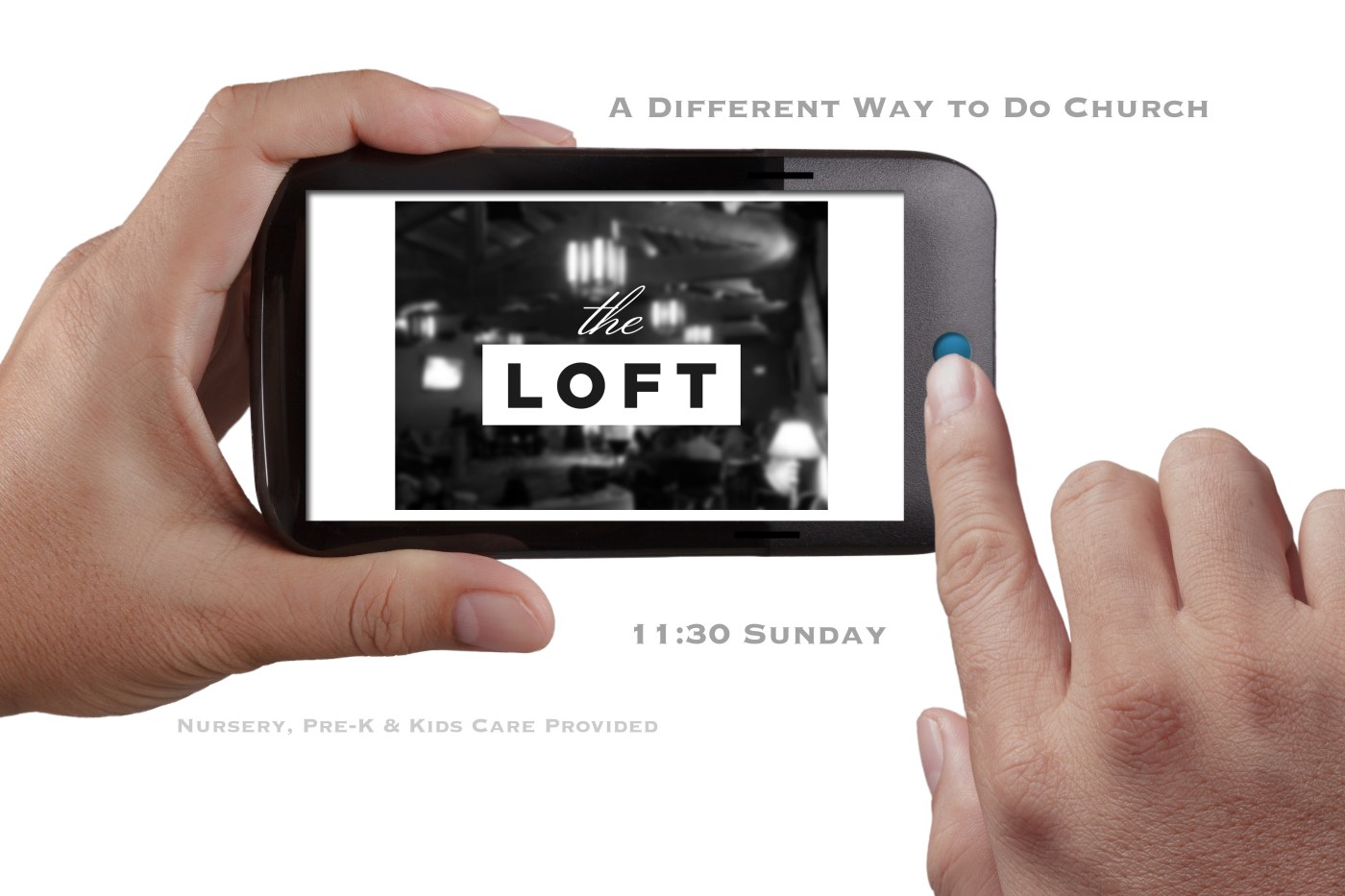
As the Minister of Children, Youth and Families I have seen dozens of young families tie into the life of the church community through the liturgical Sanctuary worship. It brings great joy to my heart to watch their little one get settled into the nursery, Pre-K or Sunday School routine and know that their child has a spiritual home that will nurture them and facilitate that child’s growth into a mature believer who can intelligently embrace a faith that will carry them for the rest of their life. Touch screen mobile phone, in hand

As the co-Pastor of the Loft I have heard dozens of stories from people who had walked away from faith and who have seen that faith resurrected in our unique environment filled with coffee, couches and conversation.

As someone raised evangelical, I confess that it makes my heart sing to hear stories of resurrected faith!

I don’t apologize for my inherited soft-spot toward stories of renewal and awakening.

Many people have stories of reclaiming their childhood faith but have no interest in continuing to hold onto childish ideas. Our faith is supposed to be child-like but the 21st century requires that it be thoughtful and vibrant.

Heading into Easter this year, I have been thinking about all of the young families who have dusted off their commitment to a faith community as well as those for whom faith had all but died, and how for both this Easter is going to seem especially meaningful.

It is an exciting time to be at a church that is committed to issues of justice, thoughtful in its approach and expanding its ability to connect with the community.

Whether it is an awakening of a dormant faith or the resurrection of something that had completely died, faith is being renewed in the life of the church.

We are an Easter people and that means we are always coming into new life.

I pray that you are as encouraged and excited as I am in the lead up to Easter. 

Police Violence Is The Exception

I posted this last week in response to two conversations with friends who are very upset by the failure of the justice system to protect unarmed black men (and boys)  from those who act on behalf of the law.

I have not been blogging much as I am in preparation for my qualifying exams in the Spring. Part of my reading has been in ‘political theology’ so I thought I might share some relevant items that I have gleaned from my studies.

______________

“Sovereign is he who decides on the exception” is a sentence by Carl Schmitt that introduces ‘political theology’. That word ‘exception’ is a key to understanding what is going on in our nation right now.

In the last four centuries ‘sovereignty’ has shifted from God and the King to the Nation and State. In that same work, Schmitt also says that “All significant concepts of the modern theory of the state are secularized theological concepts.”‘

The State* now has both the ceremony (pledge of allegiance – national anthem at all sporting events, etc.) and the power (rightful claim to foreign and domestic violence).

In a fantastic article by Bruno Gulli examining Schmitt, Gulli explains “any person with special powers (or even simply a special sensibility) could be recognized as sovereign. This would be an honorary status conferred on him.”

 The State, and those who defend it – whether police or military – have the power of exception. It is important to understand it that:

  •  The playing field is not level. It is slanted.
  •  The rules do not apply equally. There is an exception.

Citizens who are upset are not permitted to be violent. They must protest in an orderly and civilized manner.

The police/riot-squad/ military are seemingly allowed to escalate and utilize violence because they have the exception of the state behind them.

We are not all playing by the same rules. Citizens have an asymmetrical relationship with the State when it comes to violence.

It is vital here to understand the insight of Max Weber when he talks about the State’s monopoly on violence. The link explains that:

“Weber describes the state as any organization that succeeds in holding the exclusive right to use, threaten, or authorize physical force against residents of its territory. Such a monopoly, according to Weber, must occur via a process of legitimation.”

Violence is a one-sided relationship. The State – and those who act on its behalf – may behave in violent ways because it will always be construed as exceptional.

Bonnie Honig, in Emergency Politics, says “The state of exception is that paradoxical situation in which the law is legally suspended by sovereign power.”

The problem is that we now live in a permanent state of emergency.

September 11, 2001 ushered in a state of perpetual exception. This applies to racial profiling, police brutality, State surveillance of its citizenry in the NSA – to name only a few.

When people are scared they willingly sacrifice their freedom and privacy in exchange for safety. The State benefits from a frightened population and people are more willing to accept the exceptional violence and excessive forced used by law enforcement. They are more likely to turn a ‘blind-eye’ or call them ‘isolated incidents’ and claim that they are being ‘blown out of proportion’.

A population is more willing to view as exceptional the excessive tactics and escalation of violence precisely because we now live in a permanent state of exception (or emergency).

What do we do now, however, when communities are not sure they are being protected by the police and in fact need protection from the police?

In the article cited earlier, Gulli reports, “At the end of his critique of the state of exception, Giorgio Agamben addresses the question of contingency, which is very important in all of his work, when, with a reference to Benjamin, he speaks of “the urgency of the state of exception ‘in which we live’” (2005)

In his eighth thesis on the philosophy of history, Walter Benjamin says:

“The tradition of the oppressed teaches us that the ‘state of emergency’ in which we live is not the exception but the rule. We must attain to a conception of history that is in keeping with this insight. Then we shall clearly realize that it is our task to bring about a real state of emergency.” (1968)

I hear people asking about the current protests, “What are they hoping to accomplish?”

One thing they could accomplish is to create a real sense of emergency that will call into question in the larger American conscience a question about the permanent state of exception that has crept in over the past decades. The supposed ‘war on terror’ and ‘war on drugs’ are but two examples of this.

None of us want to live in a police state.
No one I know wants to live in a state of fear.
That it why we must question the exceptional violence and emergency politics that have become too normalized and quietly accepted in our society.

The people are raising their voice in protest of this exceptional violence.

_______________________

* I will be capitalizing ‘State’ to illustrate its elevated and exceptional status.

** I know four people in law enforcement and they are all amazing, loving, kind, people. My concern is about a larger mechanism in our society.

For a powerful response to Schmitt, see Paul Kahn’s Political Theology: Four New Chapters On the Concept Of Sovereignty 

Wake Up! Advent, Shopping and Sleeping

We are trying something new for Advent this year at Homebrewed Christianity. Each week we are looking at the 4 suggested texts from the lectionary and talking about how we would approach them.KONICA MINOLTA DIGITAL CAMERA

In week one there were 3 texts that we resonated with and a fourth that we struggled with. That fourth text was Mark chapter 13 where Jesus talks about signs of the end, fig trees and catastrophe.

The one thing that I do like about the fourth text is the exhortation to ‘stay alert’. There are many passages in the Bible that call us to wake up or stay alert. It is a theme that always gets my attention.

 What are we in danger of falling asleep to?

What is causing that slumber?

Some would want to answer with a classic concepts like human nature, the effects of sin, or some other predictable formulation. While those may all be true, the danger has never been greater nor the effects as pervasive as they are in 21st century.

We live in an odd time of global markets, multi-national corporations and rampant consumerism. Ours is an age of media saturation, electronic daze and commercial overload.

I have found the tool of Critical Theory helpful in analyzing our age of what Cornell West calls ‘weapons of mass distraction’. High modernity has brought us both amazing goods and services (think cell phones and the internet) as well as unprecedented capacity for destruction and devastation.

The formative thinkers in the field of Critical Theory were responding to the massive shifts of the 20th century and the realities of two World Wars that exposed human suffering and the capacity of evil in new ways. Not only did we have Hiroshima and Auschwitz but we had them on film. Some talk about this being the end of ideology (utopia) and the resulting loss of hope.

I have adapted and modified some relevant concepts from my reading and will be using them this weekend for Advent week 1. The questions this week are:

What have we fallen asleep to?

What is causing the slumber?

To what do we need to be awakened?

Black Friday is the high holy day of capitalism. Consumerism is a seductive and intoxicating atmosphere – it is the air that we all breathe in late modernity.

Consumerism, however, has a numbing effect that dulls our senses and saps our energy. This happens in 3 predictable phases.

  1. Alienation
  2. Disillusionment
  3. Resignation

 Alienation is the result of humans being commodified and thus separated from that which they produce. It also isolates us from one another as we are simultaneously objectified as consumers and subjected to an onslaught of ads that inform us we are not good enough, we don’t have enough and that the thing we don’t have would make us happy-attractive-successful.

 This leads to disillusionment because we buy stuff, we pay for services, we upgrade, we super-size … and yet it does not satisfy. We are dis-couraged. Aren’t we supposed to live in a post-racial America? What is one supposed to do in the fallout from the recent economic collapse and ongoing environmental devastation?

The final stage is resignation. The machine is too big. It feels like we are just cogs in a giant mechanism of consumption, corruption and growing disparity. The game is rigged and we know it. But we need stuff so we work more than we ever have and are less satisfied. We watch the news and see how bad is out there and we want to retreat into our screens and games. From Candy Crush to Fantasy Football we are active participants relegated to passive spectators.

We are slowly lulled to sleep in the system and numbed to the needs of our neighbors.

What can one person do in the face of this overwhelming and all-encompassing structure of society?

 Wake Up! Stay Alert! Don’t be dis-couraged.

That is the call of the texts this week. Don’t get distracted by falling stars and light-less moons. Listen to what Jesus is saying. He is telling you that it is going to get bad. Yes there will be progress in certain ways … but don’t be deceived: evil just morphs and takes on other forms.

We can celebrate that slavery ended for one part of the population… but realize that there are more humans in slavery right now than at the height of the slave trade.

Racism is not as overt as it once was … but now it morphed into a New Jim Crow and Dog Whistle Politics.

Wake Up! Stay Alert!

If the slumber results from alienation, disillusionment and resignation then the beginning of waking up is three-fold as well.

  • Realize that the game is rigged. The rich get richer and the poor get poorer.
  • Admit when you feel giving up, giving in and checking out. We need each other (see the 1 Cor text from Advent 1)
  • Listen to a community that is different from your own. Don’t be deceived that all you can see is all that is going on.

Do these three things and you will be amazed at what you are awakened to.

If you are interested you can listen to the episode – Mark 13 starts around the 1 hour mark.

You can also sign up for the class for December.

Create a free website or blog at WordPress.com.

Up ↑